New Puppy: The Complete Care Guide
By Michael Probert · Updated June 2026
Bringing home a puppy is wonderful and, if we are honest, a little terrifying. This is the calm, step-by-step guide we wish we had had — what to buy, what to do first, and how to keep your new best friend safe and happy.

To prepare for a new puppy, set up a crate, bed, bowls, complete-and-balanced puppy food, a collar, harness, leash and safe chew toys, then puppy-proof your home and book a first vet visit. The early days are mostly about a calm routine — sleep, feed, toilet, play — plus gentle crate and potty training, not perfection.
If your head is spinning, take a breath. Almost every new owner feels overwhelmed in the first week, and almost every puppy turns out just fine. At Honest Hound, we like to think of puppy care as three simple systems working together: a safe environment, a predictable routine, and a good partnership with your vet. Get those three roughly right and you do not have to be perfect on day one. This guide walks you through each one, in the order you will actually need it.
What do you need before you bring a puppy home?
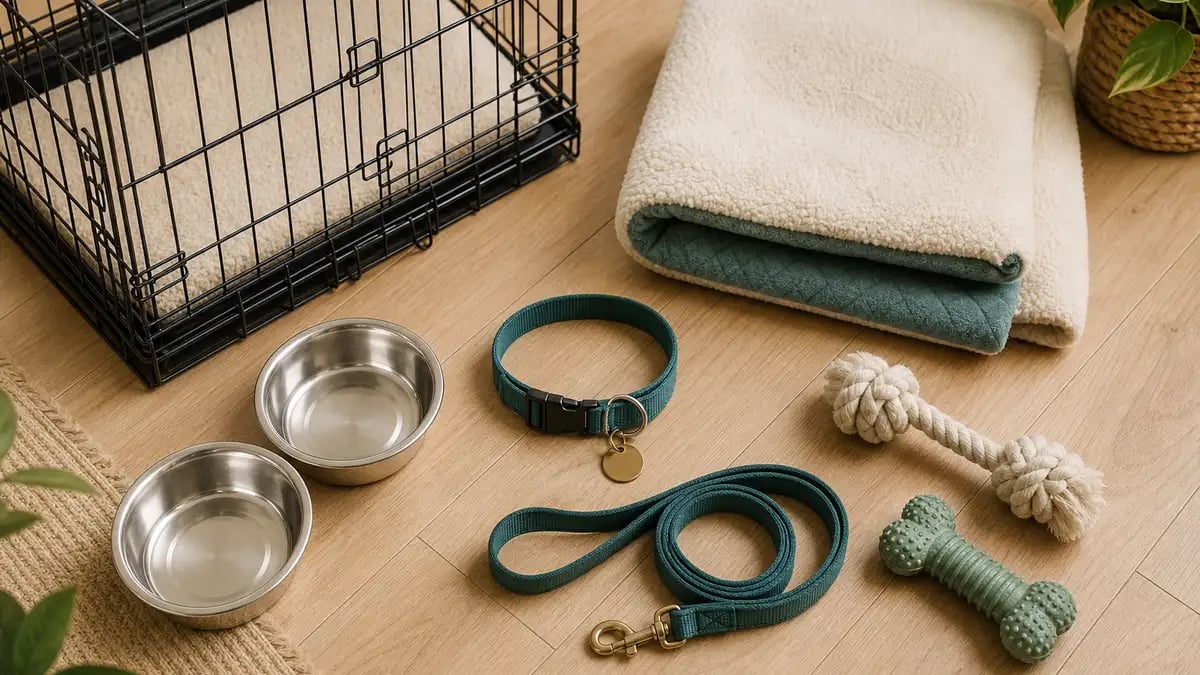
Before your puppy arrives, you need a small set of essentials: a correctly sized crate, a washable bed, food and water bowls, complete-and-balanced puppy food, a collar with an ID tag, a well-fitted harness and leash, safe chew and teething toys, an enzymatic stain and odor remover, and baby gates or a playpen. Puppy-proofing the home and booking a first vet visit matter just as much as the shopping.
Veterinary and canine organizations agree that preparing the space ahead of time dramatically reduces accidents, stress, and squabbles for everyone — puppy and people alike. The American Kennel Club's new-puppy checklist and the Merck Veterinary Manual point to roughly the same starter kit. Here is the honest version of what you actually need first.
A crate just big enough to stand, turn and lie down in; a washable bed or mat; baby gates or an exercise pen to limit roaming.
Stainless steel or ceramic bowls, a measuring cup, and a puppy food labeled complete and balanced for growth (AAFCO).
A flat collar with an ID tag, a well-fitted harness, and a 4–6 ft leash for early leash practice and safe trips out.
Safe chew and teething toys, small training treats, and an enzymatic stain and odor remover for the accidents that will happen.
A quick word on the crate: the AKC recommends it be just large enough for your puppy to stand up, turn around, and lie down comfortably — no bigger. Too much room and a puppy will happily toilet in one corner and sleep in another, which makes house training harder. Many crates come with a divider so they can grow with your pup.
Puppy-proofing is simply baby-proofing for dogs, and it is worth doing on your hands and knees so you see the room from your puppy's eye level. Tuck away or cover electrical cords, close or move trash cans, pick up small swallowable objects, shoes and laundry, and block stairs or balconies with a gate until your puppy is ready. Crucially, lock away anything toxic — medications, cleaners, and certain foods — which we cover in detail near the end of this guide. The new-puppy checklist from Gardens Animal Hospital is a good prompt for the walk-through.
One more job for this stage: agree the house rules with everyone you live with before the puppy arrives. Where will they sleep? Are they allowed on the sofa? Who does the morning toilet trip? Puppies learn fastest when every human gives the same signals, so a five-minute family chat now saves a lot of confusion later. For the full kit, see our honest guide to the dog gear you actually need — and what you can happily skip. Every pup also needs a first collar and leash: see our picks for the best dog collars and leashes. Our step-by-step guides to crate training and potty training walk you through those, gently.
What should you do in the first 24 hours?
In the first 24 hours, keep things calm and small. Bring your puppy home in a secure crate or harness, take them to their toilet spot, then let them explore one quiet room rather than the whole house. Offer water, a familiar-smelling blanket, and gentle praise, keep visitors to a minimum, and plan to sleep near the crate for the first night so the transition feels safe.
The day you bring your puppy home sets the tone, so resist the urge to run errands or throw a welcome party. Travel straight home with your puppy safely restrained — never loose on a lap — and when you arrive, head first to the spot you have chosen for toileting. Using the same place each time and quietly praising any success starts building the right association from minute one. If your puppy is too young for outdoor exposure, or you are in an apartment, ask your vet about safe options such as puppy pads or easy-to-clean balcony turf. Merck notes that puppies stay vulnerable to infections like parvovirus until their vaccine series is complete, so keep them away from places unknown dogs frequent.
Indoors, let your puppy investigate at their own pace in one contained area where the crate, bed, water and a couple of toys are already waiting. Keep first meetings with young children gentle and seated: encourage kids to let the puppy come to them, and never to chase, grab, or disturb a puppy who is eating or sleeping. Short, positive, low-key — that is the whole goal of day one.
You should also have your first vet visit on the calendar. US clinics commonly recommend booking it within the first week. At that appointment, the vet does a full physical exam, checks a stool sample for intestinal worms (very common in puppies, often passed from the mother), reviews the vaccination history, and talks through nutrition, deworming, and parasite prevention. Having this booked before the puppy lands means you are not scrambling for an appointment in the chaotic first days.
How do you survive the first week?

To survive the first week, build a gentle, repeating rhythm of sleep, eat, toilet and play, and begin crate and potty training without overwhelming your puppy. Keep training sessions to a minute or two, take very frequent toilet trips, protect lots of nap time, and aim for small wins. The goal of week one is a calm, trusting puppy who is learning the home is safe — not formal obedience.
Young puppies sleep a great deal, often 16 to 20 hours a day in short bursts. It sounds counterintuitive, but an over-tired puppy usually becomes more wired and mouthy, not less, so erring toward more naps and shorter play makes the whole week smoother. Around that rest, the same cycle simply repeats: wake, toilet, a little food or play, then settle again.
Two pieces of gentle training start now. Crate training begins by making the crate a happy place rather than a confinement device: leave the door open, toss treats and toys inside, and feed some meals in there so your puppy chooses to go in. The AKC's step-by-step approach builds up slowly — awareness, exploring, brief closed-door moments heaped with rewards — and never uses the crate as a punishment. Potty training rests on three things: management (preventing accidents), timing (frequent trips to the same spot), and reinforcement (praise and a treat the instant they go in the right place). Scolding after the fact does not work — puppies do not connect a telling-off with something they did minutes ago — and it can teach them to hide instead.
Take your puppy out first thing in the morning, last thing at night, after every nap, after meals and drinks, after play, and at regular intervals in between. A widely cited AKC rule of thumb is that a puppy can hold its bladder for roughly its age in months — so a two-month-old may manage only two to three hours — which is exactly why those frequent trips matter. Throughout the week, keep gently handling your puppy's ears, paws and mouth followed by a treat; it makes future grooming and vet visits far easier. When your pup is ready for a home trim, our guide to the best dog clippers for home grooming covers what to look for. Our step-by-step crate training guide and potty training guide walk through both in detail. And our puppy's first week checklist gives you a calm, day-by-day framework for that critical first week.
What and how should you feed a puppy?
Feed your puppy a complete-and-balanced commercial puppy food formulated for growth (look for an AAFCO statement on the label), split into several small meals a day. As a general guide, that is about four meals a day from 6 to 12 weeks, three from 3 to 6 months, and two from 6 to 12 months. Keep fresh water available always, monitor body condition, and check anything unusual with your vet.
Nutrition is a cornerstone of healthy growth, and the American Veterinary Medical Association encourages owners to treat diet as a normal part of every check-up rather than an afterthought. Choose a food clearly labeled as complete and balanced for growth or for all life stages including growth. Large and giant-breed puppies have particular needs around calorie and mineral balance and can take up to two years to fully mature, so if you have a big puppy, ask your vet about the right formula and when to switch to adult food.
Feeding-frequency guidance adapted from the Merck Veterinary Manual. Exact amounts depend on your puppy's weight, body condition and the food's own label — adjust with your vet.
Several small meals suit a puppy's small stomach and high energy needs better than one or two big ones, and they also create predictable toilet windows, which is a gift for house training. We generally avoid free-feeding (leaving food down all day) because it makes it hard to spot a dip in appetite — often the first sign something is off — and harder to line meals up with toilet trips. Watch your puppy's stools too: consistently loose, bulky or very smelly stools can mean a food is not agreeing with them and is worth a chat with your vet.
Treats are brilliant for training but count toward the day's calories, so reach for tiny, soft treats — or just use kibble from the daily ration — and skip large, fatty chews that can upset a young tummy. A quick body-condition check helps: you want to feel the ribs easily under a light layer, see a slight waist from above, and a gentle tuck-up from the side. We will go deeper on choosing a puppy food in a dedicated guide later; for now, a reputable growth-formula food and your vet's input will serve you well.
What vet care and vaccinations does a puppy need?
A puppy needs a series of core vaccinations, routine deworming with stool checks, and a plan for flea, tick, and heartworm prevention. In the US, core vaccines usually start at 6 to 8 weeks and repeat every 3 to 4 weeks until at least 16 weeks, with a booster about a year later; rabies is typically given from around 12 weeks and is required by law. Your vet tailors all of this to your puppy and your area.
Puppies are born with some protection from their mother's antibodies, but those same antibodies interfere with vaccines until they fade — which is why vaccines are repeated every few weeks rather than given just once. Most US vets use a combination vaccine often called DHPP, covering distemper, adenovirus, parvovirus and sometimes parainfluenza. The WSAVA's 2024 vaccination guidelines advise starting core vaccines no earlier than 6 weeks and revaccinating every 3 to 4 weeks until at least 16 weeks, sometimes extending to 20 weeks for higher-risk pups.
General schedule synthesized from AAHA + WSAVA-based summaries and WSAVA's 2024 table. Non-core vaccines (e.g. leptospirosis, Bordetella) depend on local risk. Always confirm with your vet.
Deworming and stool checks. Intestinal worms are common in puppies, so vets routinely deworm them and re-check a stool sample every 2 to 4 weeks until there are at least two clear results in a row. This protects your puppy's growth and also reduces the small risk of worms passing to people, especially young children. Many monthly heartworm preventives also cover certain intestinal worms, which keeps things simple — your vet will explain exactly what each product does.
Fleas, ticks and heartworm. The American Animal Hospital Association notes that fleas and ticks cause more than itching: ticks can transmit diseases such as Lyme, and a heavy flea burden can cause dangerous anemia in a small puppy. Heartworm, spread by mosquitoes, is a serious concern across much of the US. The Companion Animal Parasite Council recommends starting prevention as early as it is safely possible, keeping it up year-round, and testing all dogs for heartworm annually — because prevention is far kinder and simpler than the complex treatment an infected dog needs. Your vet will match the right products to your puppy's age, weight and where you live.
One reassuring note on cost: the AVMA points out that routine preventive care — check-ups, parasite control, vaccines — is generally far cheaper than treating a preventable illness, and they encourage owners to talk openly about budget so a vet can tailor a sensible plan. Wellness plans, a small emergency fund, or pet insurance can all take the financial worry out of the picture.

Want all of this on one printable page?
Get our free, printable New Puppy Checklist — the gear, the first-week routine and the vet timeline on one page. Pop your email in below and we'll send it straight over, plus one calm, useful email a week.
Get the free checklistHow do you start training and socialization?
Start training and socialization gently in the first weeks, using rewards rather than punishment. Teach your puppy's name and one or two cues like "sit" in one-minute sessions, and expose them safely to lots of new but positive experiences. The socialization window runs from about 3 to 14 weeks, so early, calm exposure to people, sounds and surfaces is some of the most valuable work you will ever do.
Early socialization is one of the strongest predictors of how confident and easy-going your dog becomes. The Merck Veterinary Manual highlights the period between about 2 and 4 months as especially important for helping puppies feel comfortable with people, animals and everyday experiences, while behavior specialists note the primary window opens around 3 weeks and runs through roughly 14 weeks. During this time, puppies tend to accept new things as normal rather than scary — which is exactly why a little effort now prevents a lot of fearfulness later.
Here is the tension every new owner faces: that golden socialization window overlaps with the time before vaccinations are complete. The answer is not to keep your puppy shut away, and it is not to take them to the dog park either — it is safe socialization. Invite calm, healthy, vaccinated dogs you trust to your home; expose your puppy to different floors, sounds, hats, umbrellas and household noises; carry them out to watch the world from your arms; and look for well-run puppy classes that accept pups from about 8 weeks and require proof of vaccination. This balanced approach is widely supported by trainers and vets alike.
For everyday training, the AKC and most modern trainers favor positive reinforcement — rewarding what you want with treats, praise, play and attention — and steering away from punishment, which can create fear. Remember your puppy is always learning, even when you are not running a session: if jumping up earns a cuddle, they will keep jumping; if you only give attention once all four paws are down, they learn polite greetings. Keep sessions tiny and fun, and keep every family member consistent.
What are the health red flags and common toxins?
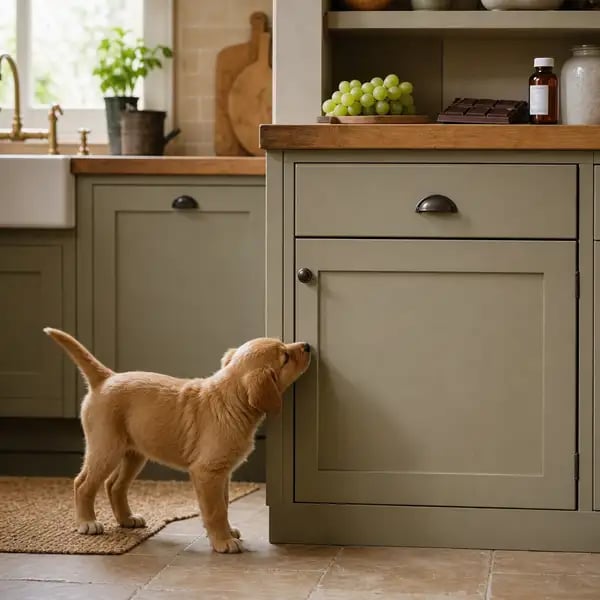
Call your vet promptly if your puppy has repeated vomiting or diarrhea, ongoing lethargy, won't eat, struggles to breathe, or may have swallowed something toxic. The most common household poisons are human medications, certain foods (grapes, raisins, xylitol, onions, garlic), chocolate, rodenticides, and cleaners. With toxins, do not wait and see — contact your vet or an animal poison control hotline straight away.
Day to day, you are your puppy's best early-warning system. A healthy puppy is bright, curious, playful in bursts, eats well, and passes formed stools. Get into the gentle habit of checking them over: feel the ribs to track body condition, glance at the gums (normally pink and moist), and look at eyes, ears and skin. A single small vomit after gulping food, or one day of slightly soft stool during a diet change, is usually nothing. Patterns — repeated vomiting, worsening diarrhea, or persistent low energy — are the red flags worth a call.
Toxins deserve real respect because puppies chew and swallow things they shouldn't. The ASPCA's Top 10 Toxins of 2025 shows that over-the-counter medications and human foods top the list, with human food and drink making up about 16% of calls and chocolate another 14%. Within food, grapes and raisins can cause kidney injury, xylitol (in sugar-free gum and sweets) can cause a dangerous blood-sugar crash and liver damage, and onions and garlic can damage red blood cells. The practical takeaway is simple: no table scraps of those foods, and store all medications, rodenticides and cleaners well out of reach.
- Grapes & raisins
- Xylitol (sugar-free gum/sweets)
- Chocolate (especially dark)
- Onions & garlic
- Human medications
- Rodenticides (rat bait)
- Household cleaners
- Some plants & essential oils
Some toxins, like xylitol, can cause serious harm before you see any obvious signs — so if you find a chewed blister pack, an empty gum packet, chocolate wrappers, or evidence your puppy reached rat bait, call for advice even if they seem fine. The ASPCA Animal Poison Control Center runs a 24-hour hotline, and your own vet or a local emergency clinic can guide you. Other everyday hazards worth managing: swallowed objects that can cause choking or blockages, chewed electrical cords, falls from heights, and overheating — puppies regulate temperature less well than adults, so never leave them in a hot room or car.
New puppy FAQ
What does a new puppy need before they come home?
A crate sized just for them, a washable bed, food and water bowls, complete-and-balanced puppy food, a collar with an ID tag, a harness and leash, safe chew and teething toys, an enzymatic cleaner, and gates or a playpen. Puppy-proofing your home and booking a first vet visit matter just as much as the gear.
How often should I feed a puppy?
As a general guide, about four meals a day from 6 to 12 weeks, three from 3 to 6 months, and two from 6 to 12 months, before settling into one or two as an adult. Follow your food's label and your vet's advice, and keep fresh water available at all times.
When do puppies get their vaccinations?
Core vaccines usually start at 6 to 8 weeks and repeat every 3 to 4 weeks until at least 16 weeks, with a booster about a year later. Rabies is typically given from around 12 weeks and is required by law. Your vet sets the exact schedule for your puppy and region.
When can a puppy be socialized safely?
The sensitive window runs from about 3 to 14 weeks, so early positive experiences count for a lot. Because protection is not complete until vaccines finish, focus on safe exposures: calm visitors, healthy vaccinated dogs you trust, varied sounds and surfaces at home, and puppy classes that require proof of vaccination.
How long can a puppy hold its bladder overnight?
A handy AKC rule of thumb is roughly the puppy's age in months, up to about 9 to 12 months — so a 2-month-old may only manage 2 to 3 hours at night. Set a gentle alarm for an overnight toilet trip rather than waiting for frantic crying.
What foods are toxic to puppies?
Keep grapes, raisins, xylitol, onions, garlic and chocolate well out of reach — the ASPCA lists human food and chocolate among the most common poisonings. Also secure medications, rodenticides and cleaners. If you suspect your puppy ate something toxic, call your vet or an animal poison control hotline right away.
How much do puppies sleep?
A lot — often 16 to 20 hours a day, in short bursts between play. An over-tired puppy tends to get more mouthy and wired, not calmer, so plan for frequent naps and keep play sessions short. Protecting rest is one of the simplest ways to make the early weeks easier.
When should I take a new puppy to the vet?
Most US vets recommend a first exam within the first week. The vet does a full physical, checks a stool sample for parasites, reviews and continues vaccinations and deworming, and talks through flea, tick and heartworm prevention for your area.
General information only — not veterinary advice. Always consult your own vet for guidance specific to your puppy.
Sources: Merck Veterinary Manual — Puppy Care; AKC — New Puppy Checklist; AKC — How to Potty Train a Puppy; AKC — Step-by-Step Crate Training; WSAVA — 2024 Dog Vaccination Table; AAHA — Health Risks of Fleas and Ticks; CAPC — Heartworm Guidelines; ASPCA — Top 10 Toxins of 2025; AVMA — Pet Nutrition; AVMA — Managing Pet Care Costs. Last updated June 2026.