How to Potty Train a Puppy (House Training, Step by Step)
By Michael Probert · Updated June 2026
If you are deep in puddles and second-guessing yourself, take a breath. House training is one of the most stressful parts of a new puppy, but it is also one of the most learnable — and your puppy is not being naughty. Here is the calm, step-by-step version.
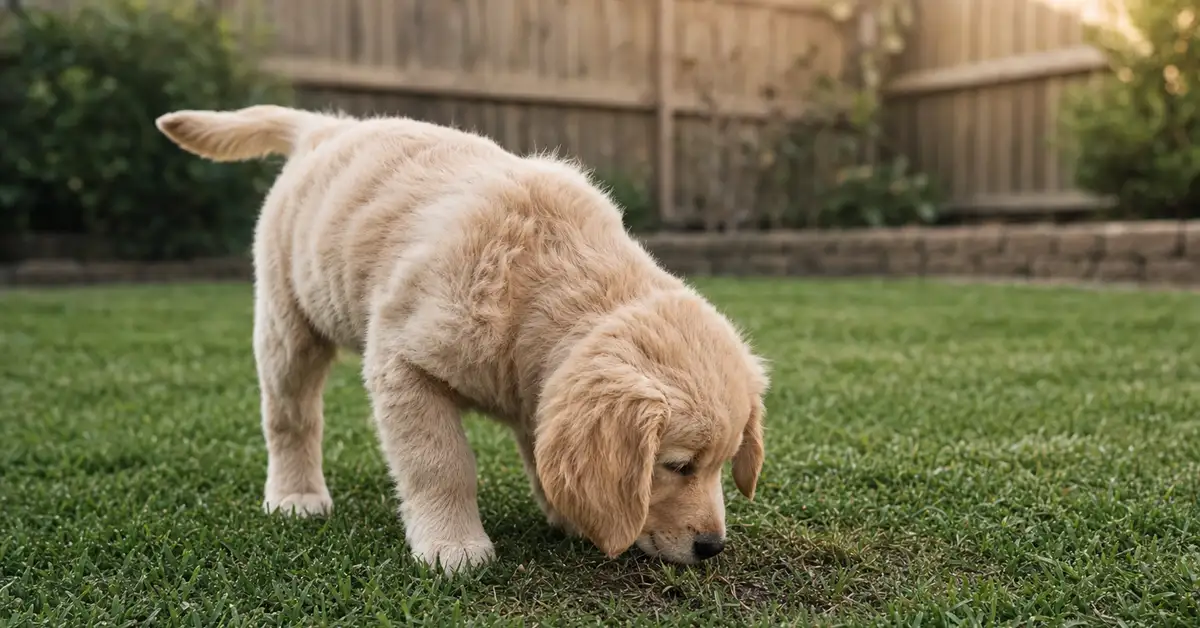
To potty train a puppy, prevent accidents with close supervision and a crate, take them out very often on a set schedule, and reward them the instant they finish in the right spot. Never punish accidents, and clean any mess with an enzymatic cleaner. Most puppies are mostly reliable by 4 to 6 months, with full reliability later.
Here is the reassuring truth most new owners need to hear: potty training is not a test of your worth or your puppy's "goodness." It is a developmental learning process that combines your puppy's slowly maturing bladder with the habits you build together.[3] At Honest Hound, we like to keep it to three simple ideas working together: prevent as many accidents as you can, repeat a predictable routine, and reward the right thing generously. Get those roughly right for a few focused weeks and the rest tends to follow.
How does house training actually work?
House training works on three pillars: management to prevent accidents, a consistent routine that teaches your puppy when and where to go, and positive reinforcement so the right spot becomes strongly rewarding. It is not about willpower or dominance — it is about anticipating when your puppy needs to go, getting them to the right place in time, and paying them well the instant they do.
At heart, this is simple learning: puppies repeat what gets rewarded and drift away from what does not.[1] They are also born with a helpful instinct — from around three to four weeks old, they naturally move away from their sleeping area before they go.[3] That clean-den instinct is exactly why a correctly sized crate supports training, and why giving a puppy the run of the whole house tends to produce quiet accidents in corners and on rugs.[10]
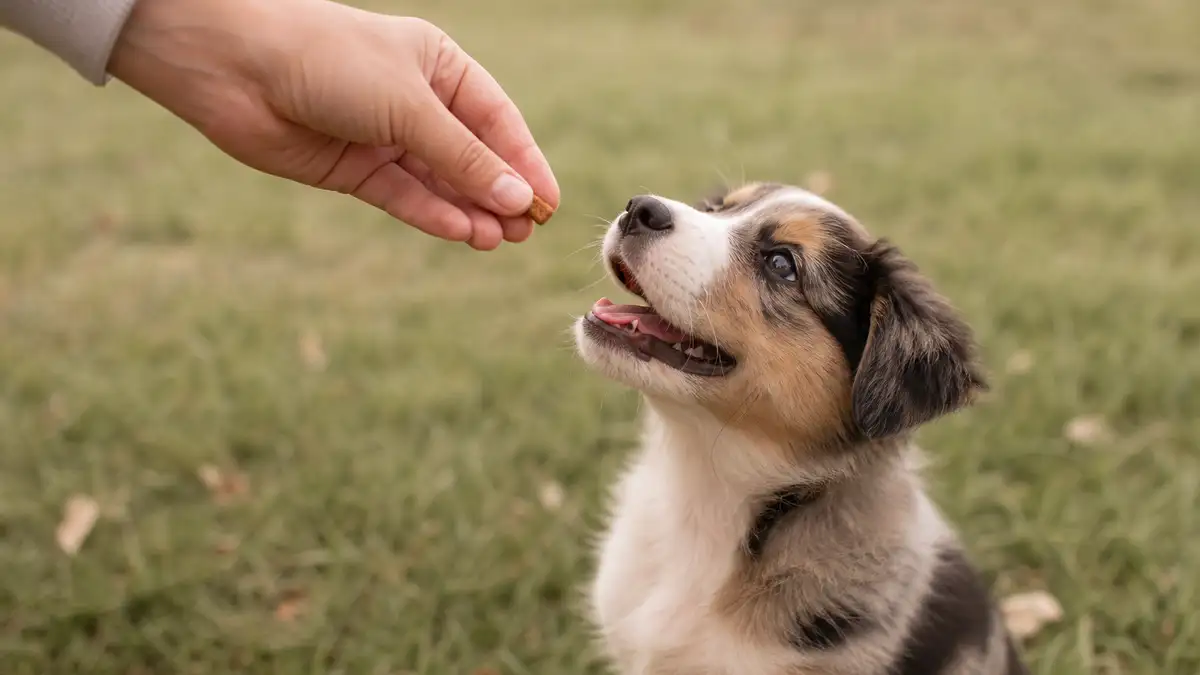
Management means controlling your puppy's world so they simply do not get the chance to practice indoor accidents. In practice that is supervising closely when they are loose, using baby gates or a leash to keep them in the same room as you, and confining them to a crate or small pen when you cannot watch.[3] Routine is the second pillar: feed at the same times each day, keep wake-play-nap cycles fairly predictable, and head to the same door and the same spot at the moments your puppy is most likely to need to go.[6] Over days and weeks, this rhythm helps your puppy's body and brain anticipate when it is time, so most of the action happens where you can reward it.
Positive reinforcement is the third pillar, and it is both a training tool and a trust-builder. Every correct potty in the right spot earns immediate praise and a small, tasty treat — within a second or two, not minutes later.[6] This is not spoiling; it is clear, science-based communication, and it is far more effective than punishment, which we will come back to. Just as important is setting realistic expectations: accidents are an expected part of learning, especially in the first few weeks, and the best thing you can do is treat each one as information rather than misbehavior.[3] Honestly, house training is usually more demanding on you than on your puppy — it asks for alarms, attention and consistency for a few weeks — but reframing it as a finite, four-to-eight-week project makes it feel far more manageable.[6]
How often should you take your puppy out?
Take a young puppy out very often: about every 30 to 60 minutes while they are awake at first, plus at every key trigger — first thing in the morning, after every nap, within 10 to 20 minutes of meals or big drinks, during or just after play, and last thing at night. A common rule of thumb is that a puppy can hold its bladder for roughly its age in months, but treat that as an upper limit, not a schedule.
That "months equals hours" guideline is widely used — a three-month-old might manage around three hours by day — but the experts who cite it are clear it is only a general guide.[6] Real-world schedules should start more frequent, until you see how long your individual puppy can actually stay clean, and then you stretch the intervals only as they earn it.[18] Expecting too much bladder control too soon is one of the most common owner mistakes, and it makes accidents more likely, not fewer.[18]
Rather than watching the clock, many owners find it easier to watch for trigger times — the moments that reliably predict a full bladder. The Wisconsin Humane Society and Purina list almost identical ones: when your puppy wakes in the morning, every time they wake from a nap, about 10 to 20 minutes after eating or a big drink, a little way into a play session, after time in the crate, and right before bed.[3] Food and water get the gut and bladder moving, and play jostles everything along, which is why these moments matter so much in a young puppy.[6] A simple mental cue helps: any time your puppy changes state — wakes, eats, drinks, plays, rests — ask, "Is this a potty opportunity?" and err on the side of taking them out.
A deliberately conservative schedule synthesized from Purina and Wisconsin Humane Society guidance. Toy breeds and puppies with health issues need shorter intervals — ask your vet. Err toward more trips, not fewer.
In practice, a typical day for an 8-to-10-week-old can easily add up to a dozen or more brief trips outside.[3] That sounds relentless, but it usually eases quickly as your puppy matures and the routine settles. By four or five months, a puppy making good progress might be down to roughly six to eight trips a day, and by six to nine months many dogs in a steady routine move to three or four main outings — though more chances to sniff and go outdoors are good for most dogs anyway.[18]
The step-by-step potty training routine
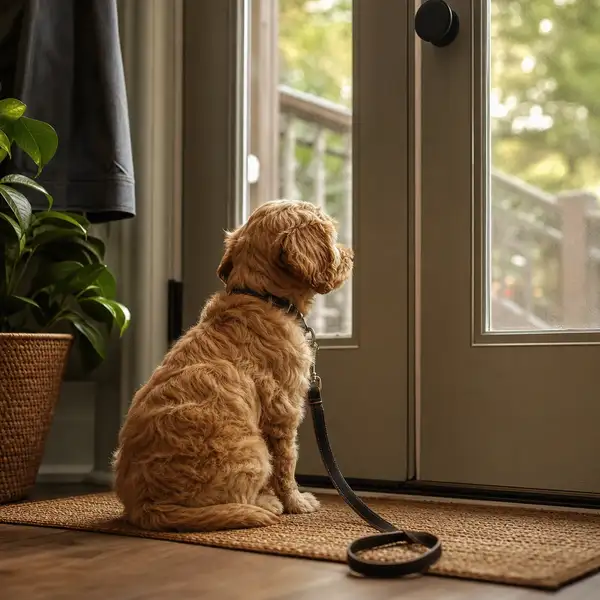
The routine itself is short and you repeat it every single time: take your puppy out on leash to the same spot, give a quiet cue word, reward the instant they finish, supervise closely indoors, confine or crate when you cannot watch, and clean any accident with an enzymatic cleaner. The magic is entirely in the repetition and the timing — do the same small thing, the same way, again and again.
The reason timing matters so much is that puppies link a reward to whatever they were doing in the few seconds beforehand. A treat given while your puppy is still sniffing the grass after a pee teaches "peeing here makes good things happen"; the same treat handed over two minutes later in the kitchen teaches "coming inside earns a snack" instead.[3] That is exactly why you go out with your puppy rather than just opening the door — so you can mark and reward the precise moment.[6] Here is the full sequence.
Clip on the leash and walk calmly to the same toilet area every time, with no play or distraction on the way. Their own scent there cues them to go again, and the leash stops them wandering off to play instead of going.[10]
As your puppy is about to start, say a short phrase once, such as "go potty" or "do your business." Say it only once and only at the spot, so it comes to mean the place and the moment — never as a nag or a scold.[3]
The moment they finish, praise warmly and hand over a small treat right there. Purina's advice is to make "a big production" with a cheerful "good potty!" — the more clearly you celebrate, the faster they learn it is a good thing.[6]
Back inside, keep your puppy in the same room with baby gates or a leash on your belt, and watch for circling, sniffing, restlessness or whining so you can get them out before an accident.[3]
When you cannot supervise, settle your puppy in a correctly sized crate or small pen. Most dogs avoid soiling their bed, which supports bladder control and tells you they will need a trip the moment they come out.[6]
Clean any indoor accident thoroughly with an enzymatic cleaner made for pet urine. If any odor lingers — even when you cannot smell it — your puppy is drawn straight back to that spot to go again.[3]
A few practical notes. Pick a spot that is feasible in all weathers — a small patch close to the door you will actually use on a dark, rainy night — because consistency early on matters more than the perfect location.[3] A crate earns its place here too: it should be just big enough to stand, turn around and lie down in, and never used as punishment, so it stays a safe den rather than a prison.[10] Crate training and house training really do go hand in hand, which is why we have a full companion guide on how to crate train a puppy. And on the enzymatic cleaner: independent testing shows the products that work contain enzymes such as proteases, and that you usually need to saturate the area and let it stay wet for a good while rather than spraying and blotting straight away.[14] We cover the gear, including cleaners, in our dog gear reviews.
How long does it take — and what about night-time?
Honestly, it depends on your puppy's age, development and environment, but it usually spans several months. Many puppies are mostly reliable in the daytime by 4 to 6 months, while full "asks to go out and rarely has an accident" reliability often is not solid until 12 to 18 months. Overnight, plan for one or two brief trips early on, and gradually stretch them as your puppy proves they can stay dry.
With consistent training, many puppies start having far fewer daytime accidents by about 12 to 16 weeks.[18] But full reliability often arrives later, around adolescence, and for some dogs is not solid until 12 to 18 months — especially small breeds or puppies in challenging set-ups like apartments with long elevator rides.[9] Needing that long is normal developmental variation, not a training failure, and it is sensible to keep up some supervision and routine until then.[18] What matters is the overall trend over weeks: more wins in the right place, fewer accidents indoors, and a growing ability to hold on for age-appropriate stretches.
Night-time worries a lot of new owners, and the kind answer is that very young puppies genuinely cannot last eight hours yet. Expect at least one, and often two, brief overnight trips in the first weeks, particularly under three months.[6] Set a gentle alarm, take your puppy calmly to the spot with no play or fuss, let them go, praise quietly, and pop them straight back to bed with the lights low so it stays clearly night-time.[3] As they show longer dry stretches, extend the gap between night trips by about 15 to 30 minutes every few nights.[18] By four or five months many puppies manage six to seven hours with a late-evening trip, and by six or seven months many sleep through, though there is a lot of individual variation.[6] Keeping water available by day but moderating very large late-evening drinks, plus a final trip right before bed, makes dry nights more likely.[6]
House training is one piece of the puzzle.
Potty training sits inside the bigger picture of those first weeks — feeding, sleep, crate training, vet visits and more. Our New Puppy Care guide pulls it all together, and a free printable checklist lives there too.
Read the New Puppy Care guideWhat about apartments and puppy pads?
If you have quick outdoor access, training straight to an outdoor spot is often simplest. But in a high-rise, harsh weather, or when you cannot get a young puppy out in time, indoor options like puppy pads or a balcony turf box are perfectly humane. The same rules apply — frequent trips, supervision, confinement when unsupervised, and an immediate reward — just aimed at a specific indoor surface instead of the yard.
The AKC describes structured pad training using exactly those principles, taking very young puppies to the pad as often as every 15 minutes and following a "better a wasted trip than an accident" approach to build a strong habit around one indoor spot.[10] If you have to be out longer than a young puppy can hold, a playpen with a sleeping area at one end and a separate pad area works well, because it lets your puppy keep "bed" and "bathroom" apart — which later eases the move outdoors.[3] An indoor turf box, with grass-like material over a drainage layer, is another popular city solution and is trained just like an outdoor spot: same schedule, same cue, supervise, reward.
The main trade-off with any indoor option is that it adds a step. Once your puppy reliably uses the pad or turf, you transition outdoors by gradually moving it toward the door, then just outside, then to the final spot, shrinking the pad along the way so your puppy relies more on the cue and the outdoor context than on the pad itself.[10] During that switch, be extra vigilant about rugs and other absorbent surfaces that can feel pad-like, and if accidents creep in, simply move the pad back a step rather than pushing on.[18] The whole thing can take several weeks, and that is fine.
Accidents, setbacks and when to see a vet
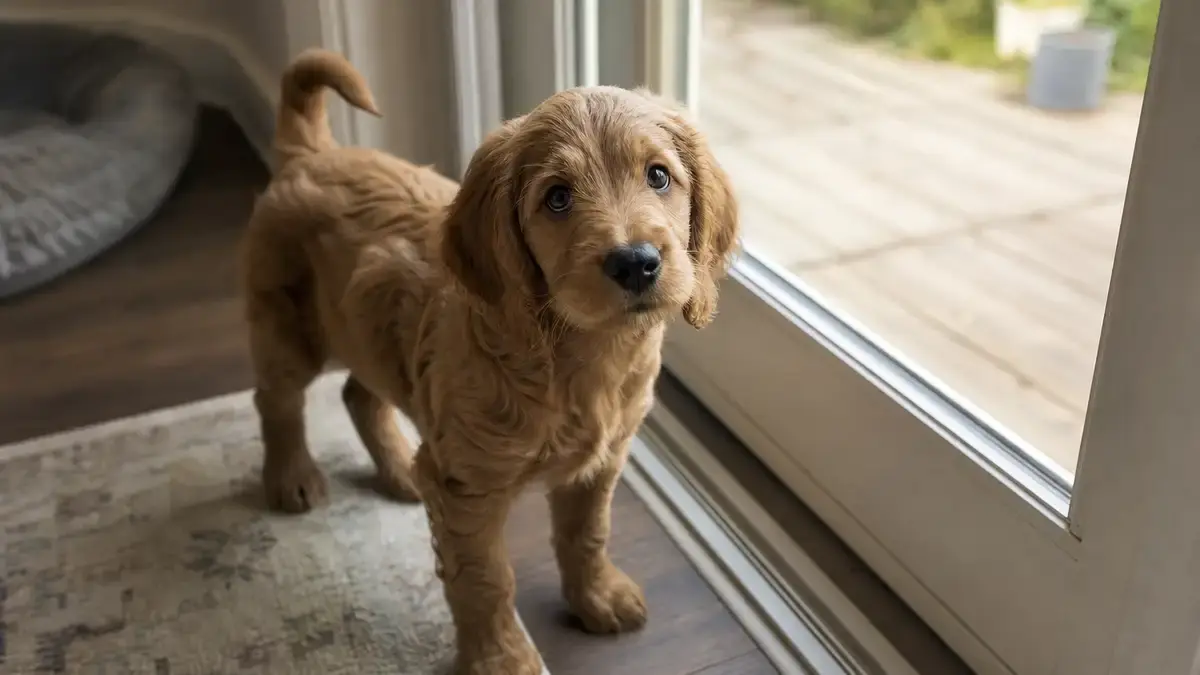
Accidents are normal and never call for punishment. If you catch your puppy mid-accident, calmly interrupt with a gentle clap or a quiet "uh-oh," then take them to their spot and reward them if they finish there. If you only find a mess afterwards, just clean it up. Most setbacks come from a routine change, stress or too much freedom — but sudden or frequent accidents can signal a medical issue worth a vet check.
The most important thing to know is that punishment backfires. Scolding, yelling or the old "rubbing the nose in it" does not teach a puppy anything useful, because they cannot connect an after-the-fact telling-off with something they did minutes ago.[3] Worse, it teaches them to be afraid of you and to sneak off and hide to go, rather than coming to you when they need out.[9] So if you discover a mess after the fact, resist the urge to point or lecture — clean it up calmly with your enzymatic cleaner and move on.[6]
When you do catch your puppy in the act, the goal is to interrupt gently, not to startle. A soft clap or a calm "uh-oh" is enough to pause them, and then you whisk them — ideally on leash — to the right spot and reward warmly if they finish there, so the sequence still ends in success.[10]
Regression — backsliding after a stretch of success — is common, especially in adolescence or around life changes, and it usually reflects human inconsistency, a change in environment, or an emerging medical issue rather than stubbornness.[18] The fix is almost always to return calmly to the basics: more supervision, more frequent trips, generous rewards, and a step back to easier conditions for a little while. A sudden bout of soft stools and accidents in a previously reliable puppy is often a diet or tummy issue, so it is worth reviewing any recent food changes.[18]
Common house-training mistakes
Most house-training trouble comes down to a handful of avoidable mistakes rather than a "difficult" puppy. The big ones are expecting too much bladder control too soon, rewarding too late or in the wrong place, giving too much unsupervised freedom, punishing accidents, and cleaning up without removing the scent. Fix these and progress usually speeds up on its own.
- Expecting too much, too soon. Stretching intervals before your puppy is ready is a classic mistake — start frequent and extend only as they earn it.[18]
- Rewarding too late, or indoors. A treat handed over back in the kitchen teaches "coming inside," not "going outside." Reward at the spot, within a couple of seconds.[3]
- Just opening the door. Sending a puppy out alone means you cannot reward the right moment, and they often come back in and go indoors instead. Go with them.[6]
- Too much freedom too soon. A puppy roaming the whole house will find quiet corners to go in. Use gates, a leash on your belt, or a pen until they are reliable.[3]
- Punishing accidents. It does not teach the lesson you want and can make a puppy hide to go. Interrupt gently if you catch them; otherwise just clean up.[9]
- Cleaning without an enzymatic cleaner. Ordinary cleaners can leave a scent that draws a puppy back. Use an enzyme cleaner and let it work properly.[14]
Potty training FAQ
How do you potty train a puppy?
Prevent accidents with close supervision and crate or pen confinement, take your puppy out very often on a predictable schedule, and reward them the instant they finish in the right spot. Never punish accidents, and clean any mess with an enzymatic cleaner so lingering odor does not draw them back. Most puppies are mostly reliable by 4 to 6 months, with full reliability often later.
How often should you take a puppy out to potty?
For a young puppy, about every 30 to 60 minutes while awake at first, plus first thing in the morning, after every nap, within 10 to 20 minutes of meals or big drinks, after play, and last thing at night. A common rule of thumb is that a puppy can hold its bladder for roughly its age in months, but treat that as an upper limit and start with shorter intervals.
How long does it take to potty train a puppy?
With consistent training, many puppies have far fewer daytime accidents by about 12 to 16 weeks and are mostly reliable when supervised by 4 to 6 months. Full reliability often is not solid until 12 to 18 months, especially for small breeds or in apartments. Uneven progress and the occasional setback are completely normal.
Should you use puppy pads or train outdoors?
If you have quick outdoor access, training straight outdoors is often simpler. Pads or an indoor turf box make sense in apartments, harsh weather, or when you cannot get a young puppy out in time. The trade-off is an extra step: once your puppy reliably uses the pad, you gradually move it toward the door and outside, and shrink it, so they switch to going outdoors.
What should you do when your puppy has an accident?
If you catch them mid-accident, calmly interrupt with a gentle clap or a quiet "uh-oh," then take them straight to their spot and reward them if they finish there. If you find a mess after the fact, simply clean it up without scolding — your puppy cannot connect a telling-off with something they did minutes ago. Always clean with an enzymatic cleaner to remove the scent.
Why is my potty-trained puppy suddenly having accidents again?
Regression after a period of success is common and usually reflects a change in routine, stress, too much freedom too soon, or a medical issue rather than stubbornness. Calmly return to the basics of supervision, frequent trips and rewards. If accidents are sudden or frequent, or you notice straining, blood in the urine, increased thirst or signs of pain, see your vet — a urinary tract infection or other problem can cause house soiling.
Should you punish a puppy for potty accidents?
No. Scolding, yelling or rubbing a puppy's nose in a mess does not work and can backfire, teaching them to fear you and to sneak off and hide when they need to go. Reward-based training, where the right spot reliably earns something good, builds the behavior far faster and protects your bond. Accidents are information about the schedule or supervision, not misbehavior to punish.
General information only — not veterinary advice. Always consult your own vet for guidance specific to your puppy.
Sources: Wisconsin Humane Society — Housetraining for Puppies; Wisconsin Humane Society — Housetraining for Adult Dogs; Purina — How & When to Potty Train a Puppy; AKC — Potty Pad and Paper Training; VCA Animal Hospitals — Puppy Training Basics; PetPlace — Potty Training Regression; Rexvet — Why Is My Dog Peeing in the House?; Good Housekeeping — Best Enzyme Cleaners, Tested. Last updated June 2026.