Dog Gear: What You Actually Need for a New Dog
By Michael Probert · Updated June 2026
Bringing home a new dog is exciting — and noisy, messy, and full of marketing telling you that everything is "essential." This is the honest version: what you genuinely need first, what can wait, and what you can skip without a second thought.
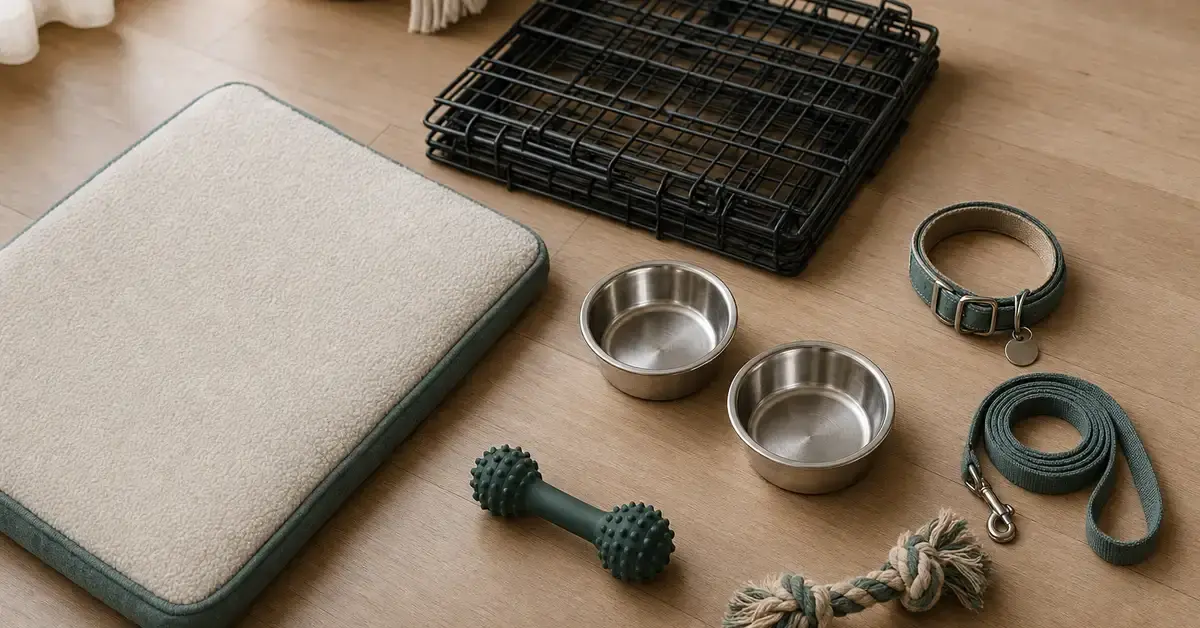
A new dog actually needs a correctly sized crate (or pen), a washable bed, two sturdy bowls, complete-and-balanced food, a collar with ID tag, a well-fitted harness and leash, an enzymatic cleaner and poop bags, a basic grooming and dental kit, and a few safe toys. Almost everything else — automatic feeders, GPS trackers, designer beds, costumes — is a nice-to-have you can add later, if at all.
If your shopping cart is spiraling, take a breath. At Honest Hound, our whole job here is to help you spend wisely, not to talk you into more. Compare the new-dog checklists from the American Kennel Club, Embrace Pet Insurance and humane societies and the same short list of functional needs keeps coming up — and a surprising amount of heavily advertised gear simply does not.[AKC][Embrace] This guide is the gear companion to our complete New Puppy care guide — start there if a puppy is about to land.
What's in the essential starter kit?
The essential starter kit is short: a correctly sized crate (or a secure pen or gated room), a washable bed, two sturdy stainless steel or ceramic bowls, complete-and-balanced food, a flat collar with an ID tag, a well-fitted harness and a 4 to 6 foot leash, an enzymatic cleaner and poop bags, a basic grooming and dental starter set, and a few safe chew toys. Have these ready before your dog comes home — the rest can wait.
This is not us guessing. Embrace Pet Insurance describes the "essential supplies" as age-appropriate food, bowls, a crate, bedding, and a collar and leash, and advises starting with these before any extras.[Embrace] The Humane Society for Tacoma & Pierce County lands in the same place, adding poop bags, toys, grooming and first-aid items and cleaning products, and the AKC layers on life-stage items such as a training leash, teething chews, training treats and early dental tools.[Humane Society][AKC]
A crate just big enough to stand, turn and lie down in; a washable bed or mat; baby gates or a pen to limit roaming early on.
Two sturdy stainless steel or ceramic bowls and a food labeled complete and balanced for your dog's life stage.
A flat collar with an ID tag, a well-fitted harness, a 4–6 ft leash, and an up-to-date microchip registration as a permanent backup.
An enzymatic cleaner and poop bags, a brush and dog shampoo, a toothbrush and paste, a nail tool, and a few safe chews.
"Essential" doesn't always mean "day one." A collar, ID tag, harness and secure leash are truly non-negotiable from the moment you take custody — a loose, unidentifiable dog can be lost in a single outing. A crate is core kit too, though some adopters of calm adult dogs phase it in over the first few days while using a gated room at first.[ASPCA]
What's not here is just as telling — decorative outfits, advanced tech, and multiple beds and bowls don't make the expert checklists, because they aren't needed for a dog's basic welfare in the early weeks.[AKC] Our full best-of buying guides for crates, beds, clippers and ramps are coming soon.
Essential vs nice-to-have: what should you buy first?
Buy the safety and welfare basics first — containment, food and bowls, ID and a leash, clean-up supplies, and a starter grooming kit — because these meet your dog's core needs from day one. Treat comfort and convenience items as a second wave you add once you know your dog, and skip or delay anything purely aesthetic or niche. The table below sorts the common categories at a glance.
This classification is intentionally conservative: if a reputable welfare organization treats an item as important for basic safety, housing, hygiene or emotional security, it sits in the "essential" column — even when there are cheaper, lower-tech ways to do the same job.[Humane Society] Items with mostly aesthetic or convenience value, or that only apply to niche situations, land under nice-to-have or skip-for-now, even when they're heavily advertised to new owners.
Categories synthesized from overlapping recommendations by the AKC, Embrace Pet Insurance and the Humane Society. "Situational" items like ramps, support harnesses and traction aids are essentials for seniors or mobility-impaired dogs and skip-for-now for healthy young dogs — more on that further down.
Sleep & containment: crates, beds, pens and gates
For sleep and containment you need two things: a way to safely confine your dog, and a comfortable place to rest. A correctly sized crate covers both jobs and supports house training; a washable bed or mat keeps your dog comfortable; and baby gates or an exercise pen let you manage the home without giving a new dog the run of the house. Buy for your dog's adult size and start with simple, easily cleaned versions.
Crates do three jobs at once: a den-like sleeping spot, house-training help (dogs learn to hold their bladder), and secure containment for travel or when you can't supervise.[Embrace][AKC] Used kindly and never as punishment, most dogs come to love a space that's theirs. Three common types: wire crates fold flat, ventilate well and usually include a divider to scale the space as a puppy grows; plastic "kennel" crates are more enclosed and the usual choice for air travel when they meet airline and USDA rules; and soft-sided crates are light for trips but unsuitable for chewers and offer little protection in a crash.[Business Insider]
A few safety details matter: secure latches a dog can't nudge open, good ventilation, a spot away from sun and drafts, and soft but washable bedding.[Embrace] Watch for collar tags snagging on bars (many owners remove dangling tags for unsupervised crating), and in the car always anchor the crate — an unsecured one becomes a projectile in a collision.[Business Insider] The most common mistake is going too big; a close second is crating a puppy longer than they can hold on — the AKC's rough guide is roughly its age in months, in hours (so a two-month-old may manage only two).[AKC]
For beds, comfort and washability beat looks. Pick one big enough to stretch out on, with a removable, machine-washable cover — new arrivals are prone to accidents, shedding and the odd sick day.[Humane Society] Heavy chewers do better on a taut cot-style bed with no loose stuffing. For seniors or dogs with joint issues, a good orthopedic bed is thick enough that they don't feel the floor, has a non-slip base, and isn't so high or soft that an arthritic dog struggles to climb in.[Humane Society] Our best-beds guide is coming soon. Playpens and baby gates round out the kit: gating off stairs, kitchens and trash is far cheaper and kinder than teaching a brand-new dog to ignore a whole house of temptations.[Embrace]
Feeding gear: bowls, slow feeders, feeders and storage
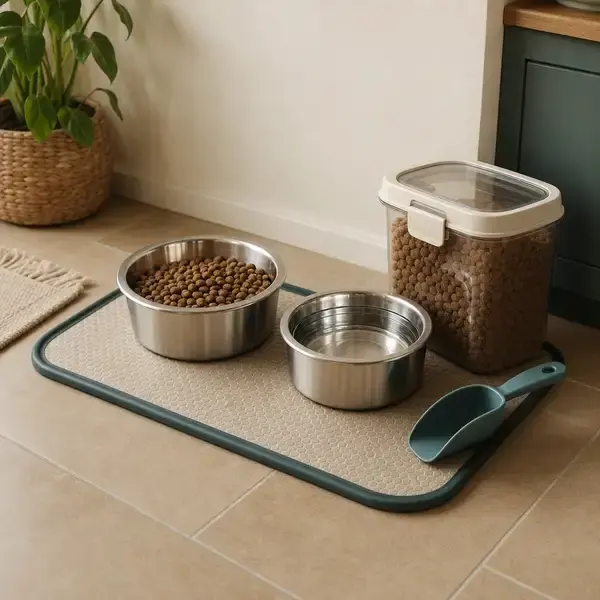
For feeding, the genuine essentials are two sturdy bowls in stainless steel or ceramic — one for food, one for water — sized to your dog's muzzle and heavy enough not to skid. Slow-feeder bowls help dogs that gulp; automatic feeders and water fountains are conveniences, not necessities, and can even get in the way of monitoring a new dog. A simple airtight bin keeps food fresh. That's really all most households need.
Material matters more than you'd think. Embrace recommends stainless steel or ceramic and warns that chewed plastic bowls develop grooves where bacteria gather.[Embrace] Good stainless steel and dishwasher-rated plastics survive hot washes, but cheaper plastics warp and develop microcracks under heat, and those cracks harbor bacteria more readily than a smooth surface. Scratches, cloudiness or a lingering smell mean it's time to replace a bowl; wash food bowls daily and water bowls every day or two to clear the biofilm.
Slow-feeder bowls, with built-in ridges or mazes, can genuinely help a dog that inhales food and then regurgitates, or one prone to gaining weight. Match the maze to the dog — shallow, widely spaced ridges suit small or flat-faced dogs, very deep ones can frustrate them — and clean them by hand, since food gets trapped in the wells. Just don't expect a bowl to fix food guarding — that's a training issue, and dogs that compete are often better fed separately.
Automatic feeders are where we'd gently pump the brakes. Embrace's essentials list leaves them out, favoring human-managed feeding so you can watch appetite and stool quality, and the AKC's potty-training guidance leans on structured, supervised meals — three small ones a day, with eyes on the results.[AKC] A programmable feeder can earn its place for a settled adult dog with long hours, but for one on a therapeutic diet or medication-with-meals, a mechanical failure carries real risk — so treat feeders as situational, not starter-kit. The same goes for big gravity waterers: refilling a regular bowl is simpler to clean and inspect, and neglected fountains grow biofilm and algae.[Embrace]
For storage, nothing fancy is needed: keep kibble in its original bag — designed to lock out moisture and oxygen — inside an airtight bin, sealed after each use and kept cool and dry. One habit saves grief: keep the bag (or at least the panel with the barcode and best-before date) rather than binning it, so you still have the lot number and expiry if there's ever a recall.
Walking & safety: harness, collar, leash, ID and the car
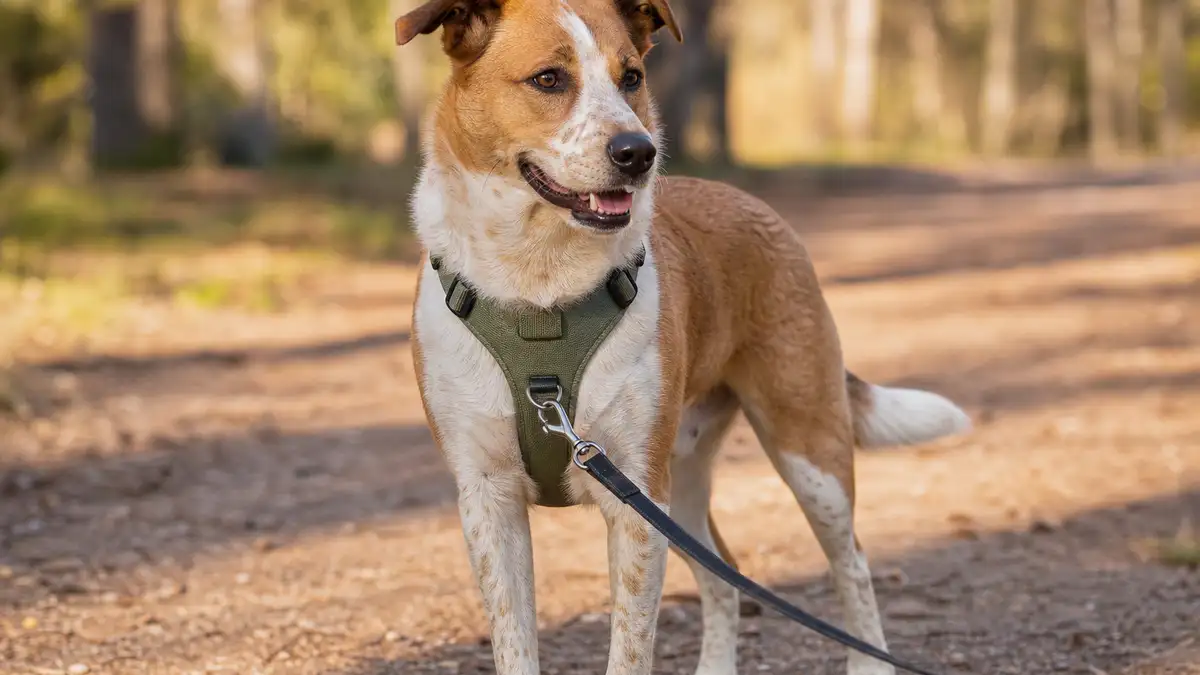
For walking and safety you need a flat collar with an ID tag, a well-fitted harness, a standard 4 to 6 foot leash, and some form of car restraint for any travel. A microchip backs up the tag as permanent ID. Fit is the part owners get wrong most often — both collar and harness should be snug enough that your dog can't slip out, but never tight. Skip retractable leashes while your dog is still learning.
A flat collar with ID tags is the cornerstone of everyday safety — your dog's way home if they slip a leash or bolt out a door.[Embrace][Humane Society] The familiar rule is two fingers between collar and neck, but the AKC's harness expert Dr. Amy Attas sharpens it: you should have to squeeze two fingers under, because if they slide in easily it may be too loose, especially on a thick-coated dog.[AKC] Puppies outgrow collars fast, so check the fit often. Because tags break or fall off, add a microchip — and keep your details registered and updated, or the chip can't do its job.[Embrace]
Harnesses spread leash pressure across the chest instead of the neck — a kind choice for puppies, small dogs, and breeds with breathing or neck vulnerabilities. Dr. Attas specifically recommends them for brachycephalic breeds such as Bulldogs, French Bulldogs and Pugs (whose necks are nearly as wide as their heads) and for older dogs or those with neck pain, breathing issues or heart disease.[AKC] To fit one, measure the chest girth behind the front legs with a soft tape, snug it so you must squeeze (not slide) two fingers under the straps, then walk your dog briefly to check for full leg freedom and no rubbing behind the elbows — and tug gently in a few directions to be sure they can't wriggle out.[AKC]
For the leash, a sturdy 4 to 6 foot nylon or leather lead with a secure clip is the safest first choice; the AKC also flags longer "training leashes" (often 10 to 30 feet) for recall in a yard or quiet park, used attentively and never around traffic.[AKC] Car travel is where marketing and reality drift apart: plenty of harnesses are sold as "car safety" without meaningful crash testing. Safety reviews are clear that a well-secured crate or a genuinely crash-tested harness beats untested gear or no restraint — an unrestrained dog can become a projectile and injure everyone in the car.[Business Insider] A crash-tested crate like the Gunner G1 is a gold standard for frequent road-trippers; for everyone else, the goal is simply some proper restraint over a loose dog on the seat or a lap.
Grooming kit: brushes, bathing, nails and dental
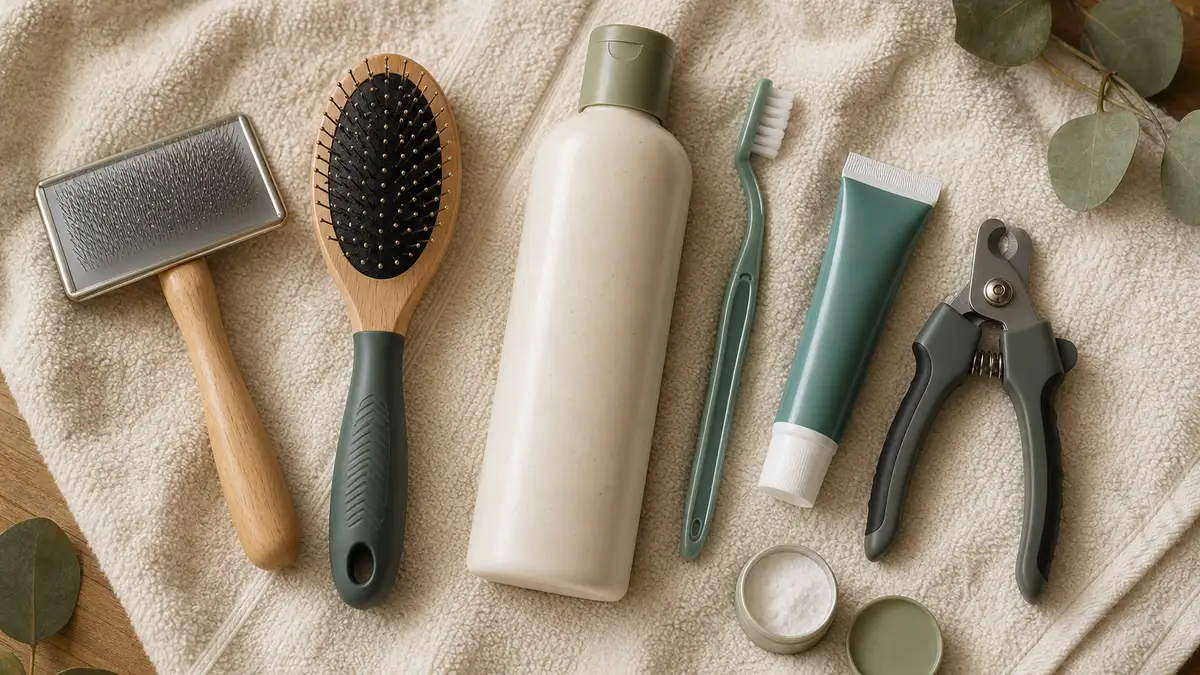
A starter grooming kit is a brush suited to your dog's coat, a dog-specific shampoo, a toothbrush and dog toothpaste, and a nail clipper or grinder, plus styptic powder for a nicked nail. Early, gentle handling is the real point: a puppy who learns that brushing, tooth-cleaning and nail trims are safe is far easier to care for as an adult. Skip the giant generic kits.
Brushes by coat. Regular brushing keeps the coat clean, cuts shedding, and lets you catch skin issues, parasites or lumps early. The AKC suggests several sessions a week, working "all the way down to the skin," and matches tools to coat: pin brushes for long hair, bristle brushes for short to medium coats, slicker brushes to lift mats and dead hair, and rubber curry combs to polish smooth coats.[AKC] Double-coated breeds like Huskies need a rake or deshedder (used carefully), and curly coats like Poodles and Doodles need wide- and narrow-toothed combs to prevent painful matting.[AKC] Embrace puts it well: every dog needs at least a brush, but long or thick coats may need more.[Embrace]
Bathing and shampoo. Bathe as infrequently as you can while keeping your dog clean, to protect the natural oils in their skin — frequency depends on breed, coat and lifestyle.[AKC] One rule is non-negotiable: never use human shampoo, whose pH doesn't suit canine skin — use a mild, dog-specific one, and rinse thoroughly so no residue irritates the skin.[AKC]
Ears and dental. For ears, a damp cloth or cotton ball with a little ear cleaner is enough — never push anything deep into the canal, and dry ears well after they get wet.[AKC] Dental care is the long game where early gear pays off most. The AKC urges frequent brushing with dog-specific toothpaste, ideally daily, starting by rubbing the teeth and gums with a finger before introducing a brush.[AKC] Embrace notes that starting in puppyhood makes it far easier, and that professional cleanings can run roughly three to six hundred dollars — so prevention genuinely saves money.[Embrace] Never use human toothpaste (it can contain xylitol or unsafe fluoride). For dental chews, look for the Veterinary Oral Health Council (VOHC) Accepted seal — its November 2025 list of accepted dog products is a quick way to tell evidence from marketing.[VOHC] A dedicated best nail clippers and grinders guide is on the way.
Gear is only half the story.
If a puppy is on the way, our complete New Puppy guide walks you through the first 24 hours, the first week, feeding, vaccines and house training — and that's where our free, printable New Puppy Checklist (gear plus routine on one page) will live.
Read the New Puppy guidePlay & enrichment: chew toys, puzzles and toy safety
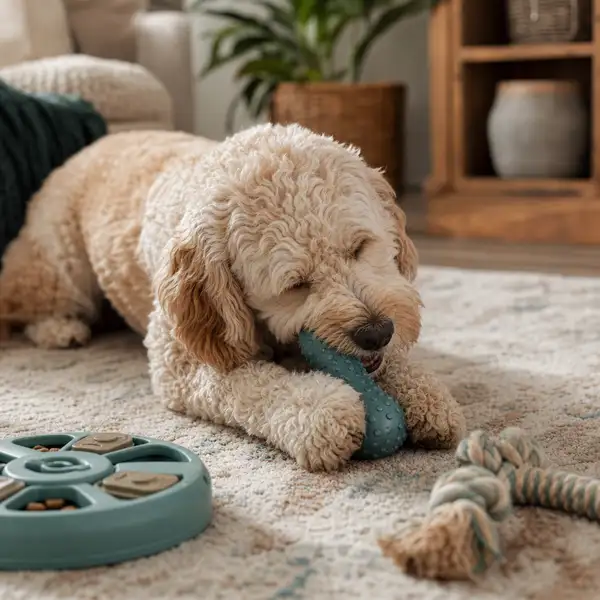
For play and enrichment, a small, well-chosen set beats a toy box overflowing on day one: a couple of sturdy chew toys (plus softer teething toys for puppies), one or two fetch or tug toys, and a simple puzzle or treat-dispensing toy. The single most important rule is size — a toy should be too big to swallow, with no small parts to come loose. Add more once you've learned what your dog actually loves.
Chewing is normal, especially for teething puppies, and the right toy protects both their gums and your shoes — the AKC notes puppies need softer, gum-soothing teething toys alongside regular chews.[AKC] On safety, the ASPCA warns that small toys are choking hazards and some plastics are toxic if chewed and swallowed — the same logic as small household objects like buttons and coins.[ASPCA] So avoid removable squeakers, loose stuffing and detachable bits. Rawhide is a genuine judgment call: the AKC explains it's meant to soften and break into small pieces, but strong chewers can tear off large chunks that pose choking or blockage risks, and swallowed pieces can sit in the stomach for months — so many owners reasonably skip it at first, choose vet-recommended alternatives, and always supervise edible chews.[AKC]
Puzzle toys matter because mental work tires a dog as much as a walk, and a busy brain chews and barks less. Humane societies and Embrace both recommend offering a variety to learn what your dog enjoys, from tug and fetch to food puzzles that occupy a dog while you're busy.[Humane Society][Embrace] Start simple — a stuffable rubber toy or basic treat ball — before complex sliding-panel puzzles that frustrate beginners. As with bowls, plastic puzzle toys develop scratches that harbor bacteria, so wash them often and replace worn ones.
Mobility, senior support & tech: is it worth it?
Mobility aids and pet tech are situational, not starter-kit essentials. Ramps, steps, traction aids and support harnesses are genuinely important for seniors, small breeds and dogs with joint problems, but optional for a healthy young dog. GPS trackers, activity monitors and cameras can add peace of mind, yet they're absent from expert welfare checklists because they don't replace ID, training, supervision and a leash. Buy these to solve a specific problem, not by default.
Mobility and senior support. The AKC notes harnesses are especially helpful for older dogs with neck pain or mobility issues, and that ramps or stairs help dogs reach beds, couches or cars while sparing their joints.[AKC][AKC] For a ramp, look for a gentle slope, a non-slip surface, and a width and weight capacity matched to your dog, with no wobble. On slippery floors, rubber-backed runners often help a wobbly senior more than booties, which many dogs resist, and padded support slings with secure handles aid dogs recovering from surgery. If you're adopting an obviously senior or mobility-impaired dog, treat a mobility aid as essential; for a young, sound dog it can wait — and let your vet guide anything orthopedic or pain-related. Our best dog ramps guide is coming soon.
Pet tech. Tech is everywhere in marketing and largely missing from the welfare basics — which tells you it enhances convenience, not core care.[AKC] GPS trackers come in two camps: cellular-and-satellite trackers give wide-area, real-time location but usually carry a subscription, while Bluetooth trackers are cheaper but short-range and rely on patchy crowd-sourced networks. Either way a tracker is only as good as its battery, network and whether it stays on the collar — so it supplements, never replaces, fencing, a leash, an ID tag and a microchip. It's well worth it for an escape-prone dog in a rural area with good coverage; for a calm homebody, less so. Activity monitors can flag subtle changes that hint at illness, but interpretation belongs to your vet. Our honest take: settle the basics, watch your dog for a few weeks, and add tech only once a real need shows up — leaning on reviewers like Wirecutter and Forbes Vetted when you do.
What can you skip — and what are the common money-wasting mistakes?
You can safely skip automatic feeders, water fountains, furniture-style and designer crates and beds, coordinated harness sets, costumes, and most pet tech in the first weeks — none appear on expert welfare checklists. The biggest money-wasters are buying before you know your dog, sizing crates and harnesses by guesswork, and trusting "indestructible" or scare-tactic marketing. Spend on safety and fit; delay the extras.
Here's the honest skip-list, with the reasoning. Automatic feeders and fountains aren't needed when someone's home enough to feed on a schedule, and manual feeding lets you spot a dropped appetite or off stool early.[Embrace] Furniture-style crates and designer beds are aesthetic upgrades; reviewers praise furniture-style crates for blending in at home, but a basic wire crate does the same job for far less and is easier to clean when a puppy chews or has an accident.[Business Insider] A wall of toys and outfits isn't necessary at first — a few safe chews and a tug or fetch toy is plenty, and the ASPCA suggests skipping costumes unless your dog enjoys them.[AKC][ASPCA] And most tech can wait until a specific need actually appears.
- Buying a crate that's too big for house training
- Sizing a harness by weight, not by measuring
- A designer bed before you know your dog chews
- Plastic bowls that scratch and harbor bacteria
- A retractable leash as a first lead
- "Car safety" harnesses that aren't crash-tested
- Trusting "indestructible" toy claims
- Generic "dental" treats with no VOHC seal
The thread running through all of those is the same: spend on safety and fit, and let comfort and convenience wait. A correctly sized crate, a properly measured harness, stainless steel bowls, a stout fixed leash and a handful of safe toys cover a new dog's real needs for a fraction of what an "everything" haul costs. That, in a sentence, is the Honest Hound philosophy — and it's why this guide tells you what to skip as plainly as what to buy. As we publish our hands-on best-of guides, we'll bring the same candor to which specific products are genuinely worth your money.
Dog gear FAQ
What gear does a new dog actually need?
A correctly sized crate (or secure pen or gated room), a washable bed, two stainless steel or ceramic bowls, complete-and-balanced food, a flat collar with an ID tag, a well-fitted harness and a 4–6 ft leash, an enzymatic cleaner and poop bags, a basic grooming and dental kit, and a few safe chew toys. Everything else is a nice-to-have you can add later.
What size crate should I get for my dog?
The AKC advises a crate just large enough to stand up, turn around and lie down — no bigger. Too roomy and a puppy will sleep at one end and toilet at the other, undermining house training. Buy for the expected adult size and use a divider to shrink the space while they grow.
How should a dog harness fit?
Measure the chest girth behind the front legs, then fit it snug but not tight. The AKC says you should have to gently squeeze two fingers under the straps — if they slide under easily it's too loose, especially on a thick-coated dog. Walk your dog briefly to check the straps don't rub behind the elbows and that they can't wriggle out.
Are retractable leashes a good idea for a new dog?
Not as a first leash. Embrace, citing humane-society guidance, notes they're often not recommended for puppies: they can encourage pulling, extend too far in busy areas, and their thin cords can cause burns or tangles. A simple 4–6 ft fixed leash gives far more control while your dog learns to walk politely.
Should I use nail clippers or a grinder?
Both can be safe and effective — it comes down to your comfort and your dog's tolerance. The AKC recommends clippers with a safety guard, trimming only the hooked tip before the quick. Grinders smooth nails gradually but are often loud, heat up if held in one spot, and can catch fur. Introduce either slowly with treats, and keep styptic powder handy.
How do I choose a safe chew toy?
Pick one too large to fit entirely in your dog's mouth or swallow in chunks, and avoid small detachable parts, removable squeakers or loose stuffing — the ASPCA warns small pieces are choking hazards and some plastics are toxic if ingested. Give teething puppies softer toys, supervise edible chews, and bin any toy chewed down small enough to swallow.
Is a GPS tracker worth it for a dog?
Helpful for some dogs but not essential — it's not on the core checklists because it doesn't replace an ID tag, microchip, secure fencing and a leash. Cellular and satellite trackers cover a wide area but usually need a subscription; Bluetooth trackers are cheaper but short-range. They make most sense for escape-prone dogs or rural areas — add one once the basics are settled.
What dog gear can I skip when money is tight?
Skip automatic feeders, water fountains, furniture-style or designer crates and beds, coordinated harness sets, costumes, and most pet tech in the first weeks — none appear on expert welfare checklists. A simple wire crate, a washable mat, stainless steel bowls, a properly fitted harness and a few safe toys cover a new dog's real needs for far less.
General information only — not veterinary advice. The right gear depends on your dog's size, age, breed and health; always consult your own vet for anything specific to your dog.
Sources: AKC — New Puppy Checklist; Embrace Pet Insurance — Puppy Essentials; Humane Society — 10 Essentials for Your New Dog; AKC — Choosing the Right Harness; AKC — How to Groom a Dog; AKC — Bath Time; AKC — Are Rawhide Chews Dangerous?; AKC — How to Potty Train a Puppy; ASPCA — Pet Hazards; Business Insider — The Best Dog Crates; VOHC — Accepted Products for Dogs. Last updated June 2026.