Best Orthopedic Dog Beds 2026: 10 Picks That Actually Support Your Dog
By Michael Probert · Updated June 2026
The word “orthopedic” on a dog bed label means almost nothing in the US — there are no legal standards and no oversight body. This research-led guide ranks 10 beds that actually earn the description, based on foam thickness, entry accessibility, and vet-informed joint-support criteria.
Quick answer:
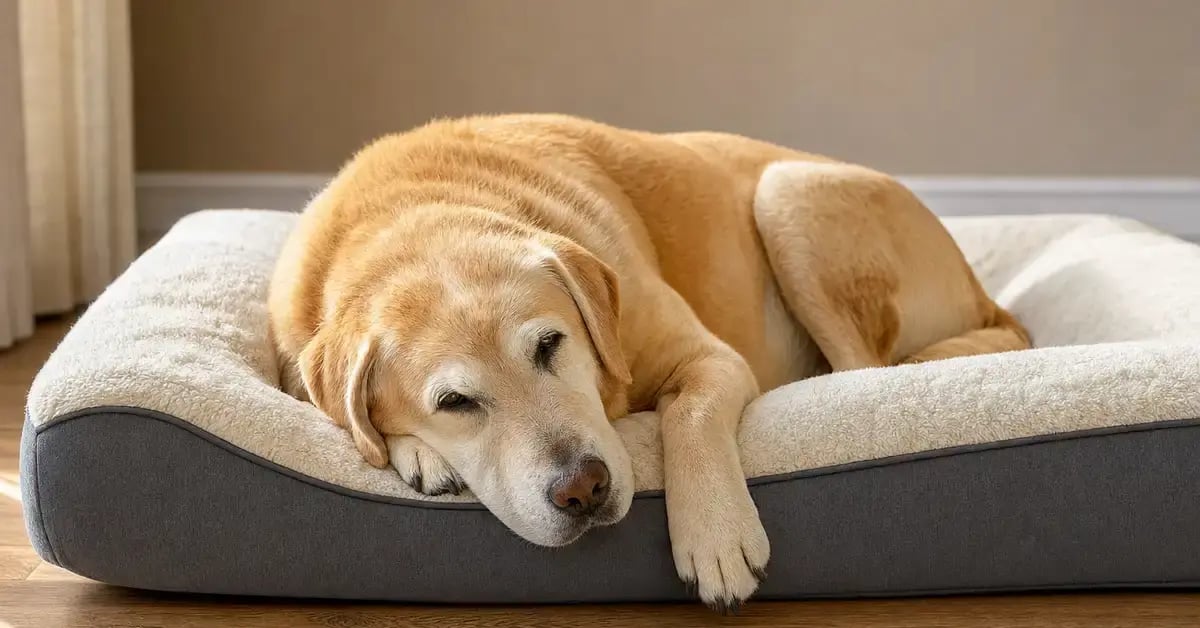
The PetFusion Ultimate Memory Foam Dog Lounge is the best orthopedic dog bed for most dogs — genuine 4-inch memory foam, a low-entry open front, and a waterproof liner at a sensible price. For large and giant breeds, the Big Barker is the only pick backed by a published clinical study. Our full ranked list covers 10 beds across all sizes, budgets, and conditions.
The word "orthopedic" on a dog bed label means almost nothing. There are no legal standards, no minimum foam thickness requirements, and no oversight body — which means a bargain poly-fill mat can legally call itself orthopedic just as easily as a therapeutic-grade memory foam mattress. For the estimated 20 million US dogs living with osteoarthritis, that distinction matters enormously.
At Honest Hound, we researched this category the same way we research all our gear picks: starting with the veterinary evidence on canine joint health, then harvesting product data from multiple reputable editorial roundups, and cross-checking any safety or certification claims at primary sources. We don't hands-on test (we're transparent about that), but we also don't pad lists — every bed below earned its place.
Why an Orthopedic Bed Makes a Real Difference
Canine osteoarthritis is more common than most owners realize. The AKC estimates that roughly one in five dogs is affected by arthritis at some point in their lives — with prevalence rising sharply in dogs over seven. Clinical signs frequently lag behind structural changes, meaning joint disease is often silently present in middle-aged dogs long before stiffness becomes visible.
A genuinely supportive bed doesn't treat arthritis — that's your vet's job — but it can materially reduce daily discomfort. When a dog lies down on hard flooring or an unsupportive mat, bony prominences (elbows, hips, shoulders) concentrate pressure at a handful of points. Dense memory foam distributes that load across the full body surface, relieving pressure at painful joints and supporting spinal alignment. Dogs with arthritis that switch to a properly rated orthopedic bed often show behavioral signs of improved comfort: more willingness to get up, fewer signs of restlessness at night, and a preference for the bed over cold hard floors.
If your dog is already showing signs of joint stiffness, this page is for you. If you're shopping for a younger or healthier dog, our best dog beds guide covers a wider range of comfort-focused styles.
Which Dogs Benefit Most From an Orthopedic Bed?
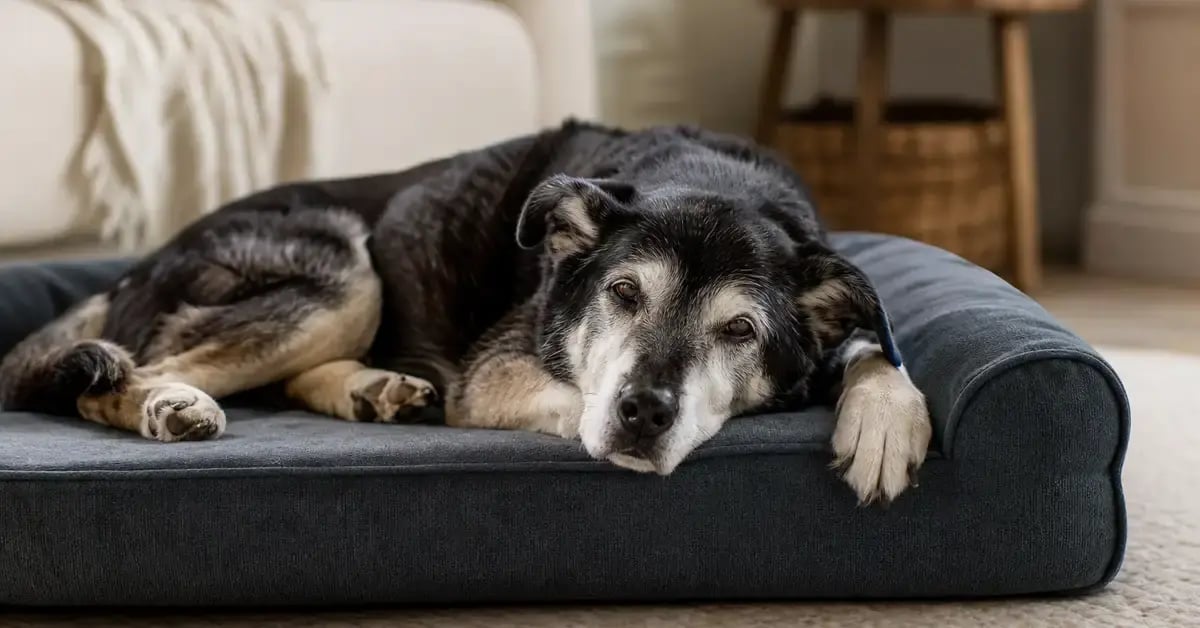
Any dog can benefit from a well-made supportive bed, but the following dogs have the most to gain:
Dogs most likely to benefit:
- Senior dogs (typically 7+ for large breeds, 10+ for small). Aging joints produce less synovial fluid and cartilage thins, making pressure relief increasingly important.
- Breeds predisposed to hip or elbow dysplasia. Labrador Retrievers, Golden Retrievers, German Shepherds, and Rottweilers are overrepresented in Orthopedic Foundation for Animals (OFA) registries. Dysplasia accelerates degenerative joint changes from an early age.
- Dogs recovering from orthopedic surgery (cruciate repair, hip replacement, fracture). Firm, supportive foam is often recommended during rehabilitation.
- Dogs with a diagnosed IVDD (intervertebral disc disease). A non-slip, flat surface reduces instability during repositioning.
- Obese dogs. Excess body weight multiplies compressive forces on joints — supportive bedding helps offset this while a weight-management plan is underway.
- Any dog showing early signs of joint discomfort: reluctance to jump, difficulty rising, or a preference for hard floors over existing bedding (a sign the current bed offers little real support).
Senior dogs with incontinence have an additional priority: a waterproof liner. If urine penetrates the foam core, no amount of surface washing will fix it — the foam will harbor bacteria and degrade quickly. Every pick on this list that we recommend for seniors includes a waterproof layer.
How We Evaluated These Beds
Our methodology
We reviewed roundups from Rover, Hepper, and additional sources, then cross-referenced product specifications against veterinary guidance on canine joint health. Each bed was assessed against four criteria before making the list:
- Foam quality & thickness. Minimum 3–4″ for small dogs; 4–7″ for large/giant breeds. True memory foam or verified therapeutic foam only — no poly-fill or egg-crate beds except where clearly labeled.
- Accessibility. Low-profile entry or open front edge for arthritic dogs. Non-slip base. No prohibitively high bolsters without a lowered access point.
- Hygiene. Removable, machine-washable cover. Waterproof liner (for senior/incontinence use).
- Third-party validation. CertiPUR-US or OEKO-TEX foam certification where claimed; no unverifiable "vet-designed" or "clinically proven" badges without a traceable source.
We don't hands-on test. We say so clearly. Price data comes from research as qualitative bands only — no scraped figures. What you see below is honest, sourced, and as accurate as we can make it.
The 10 Best Orthopedic Dog Beds for 2026
These 10 beds were selected after reviewing editorial roundups and cross-referencing vet guidance on foam specifications. Each one cleared all four criteria above and covers a distinct use case — from budget pads for smaller dogs to large-breed heavy-duty mattresses backed by clinical evidence.
All 10 are available on Amazon. Prices are shown as qualitative bands ($–$$$$) because Amazon prices fluctuate — check each listing for current pricing. Links use Amazon's standard untracked search until we're enrolled in Amazon Associates.
PetFusion Ultimate Memory Foam Dog Lounge
Best for: Dogs with arthritis, most sizes and budgets. The most widely recommended pick across multiple reputable roundups.
PetFusion's flagship bed uses true memory foam — the same polyether-polyol construction found in quality human mattresses — that molds to your dog's frame and returns to shape when they stand up. The large size provides 4 inches of foam; the jumbo bumps that to 6 inches, which is adequate for most large breeds. Three-sided polyfill bolsters provide head-and-neck support while a deliberately low open front makes it easy for arthritic dogs to step in without climbing. A removable water-resistant cover takes machine washing well, and a separate waterproof liner protects the foam core from accidents.
Pros
- Genuine memory foam (not poly-fill)
- Accessible open-front design
- Waterproof liner included
- 36-month warranty
- 4 sizes: small → jumbo
Cons
- Some user reports of zipper durability issues
- Small size only 2″ foam (fine for small dogs only)
Sizes: Small (25×20×2″) / Large (36×28×4″) / XL (44×34×4″) / Jumbo (50×40×6″)
See on Amazon →Big Barker Orthopedic Dog Bed with Headrest
Best for: Large and giant breeds (50–300 lbs). The only orthopedic dog bed with a published clinical trial.
Big Barker occupies a category of its own: three layers of US-made therapeutic foam reaching 7 inches thick, CertiPUR-US certified, and rated to support dogs up to 300 lbs without bottoming out. A clinical study conducted at the University of Pennsylvania found that dogs sleeping on Big Barker beds showed improvements in joint stiffness and mobility — the kind of evidence almost no dog bed manufacturer can point to. It comes with a 10-year warranty guaranteeing the foam will retain 90% of its original shape. The headrest edition adds a raised section for neck support. It's expensive, but for a dog with serious joint disease it's a considered investment in daily comfort.
Pros
- Only clinically studied orthopedic dog bed
- 7″ thick; 3-layer therapeutic foam
- CertiPUR-US certified; US-made
- 10-year shape warranty
- Supports dogs to 300 lbs
Cons
- Premium price point
- Not dig-resistant; better suited to calmer senior dogs
- Requires significant floor space
Sizes: Large (48×30×7″) / XL (52×36×7″) / Giant (60×48×7″)
See on Amazon →FurHaven Nap Ultra Plush Orthopedic Pad
Best for: Dogs with hip dysplasia, sprawlers, and budget-conscious owners who need genuine foam support without bolsters.
Dogs with hip dysplasia can struggle with beds that are too squishy — they need something firm enough to prevent the femoral head from sinking awkwardly. This flat FurHaven platform delivers: the foam ranges from 3 inches (small) to 5 inches (jumbo plus), with a density that provides consistent support rather than caving underfoot. The flat surface and absence of bolsters mean dogs with limited hip rotation can approach and settle from any angle. It's machine-washable, available in five sizes, and supports dogs up to 125 lbs on the largest model — and the price won't make your eyes water.
Pros
- Flat design; accessible from all angles
- Firm dense foam; good for hip dysplasia
- Affordable; 5 sizes
- Machine-washable cover
Cons
- No waterproof liner (add a separate pad for incontinent dogs)
- Plush cover may attract some chewers
Sizes: Small → Jumbo Plus (up to 125 lbs). Foam: 3″ (small) to 5″ (jumbo plus).
See on Amazon →Dogbed4less Gel-Infused Memory Foam Dog Bed
Best for: Senior dogs, especially those who overheat or have incontinence. The gel-infused foam adds a temperature-regulation advantage.
This flat-profile bed packs 4 inches of gel-infused memory foam — the gel microbeads help dissipate body heat, which matters for seniors with dense coats or those prone to overheating. For senior dogs dealing with incontinence, the setup is thoughtfully complete: a waterproof foam liner is included, plus two removable outer covers (one denim, one microsuede) so you always have a spare in the wash. An anti-skid base is a sensible addition for dogs with reduced mobility trying to reposition themselves. Six sizes from small to 3XL make it one of the most range-accommodating picks on this list.
Pros
- Gel-infused foam for temperature regulation
- Two washable covers included
- Waterproof liner
- Anti-skid bottom; 6 sizes
- Affordable price point
Cons
- Flat design may not suit dogs who like to lean against a bolster
- Cover fabrics are functional rather than premium
Sizes: Small → 3XL. Foam: 4″.
See on Amazon →K&H Pet Products Pillowtop Orthopedic Bolster Bed
Best for: Anxious dogs, curlers, and eco-conscious owners who want both joint support and a comfortable leaning surface.
Many anxious dogs sleep better when they have something to press against — a bolster satisfies that need while the bio-based orthopedic foam underneath handles the joint-support job. K&H's Pillowtop bed is a notably sustainable option: the foam base uses bio-based materials, and the bolster poly-fill is made from recycled bottles. The fluffy sherpa pillow-top adds warmth and comfort for thin-coated dogs. Both the foam mattress section and the bolsters have individual zippers, so everything can be washed separately — a genuine practical advantage over beds where the whole thing has to be wrestled into a machine at once.
Pros
- Bio-based foam + recycled-bottle fill
- Bolsters great for anxious, leaning sleepers
- Fully washable — mattress and bolsters individually
- Stylish; works well in living room settings
Cons
- Fluffy pillow-top may not survive determined diggers
- No waterproof liner
Notes: Check Amazon listing for current size availability.
See on Amazon →Casper Dog Bed
Best for: Small and medium dogs up to 90 lbs. Made by the human mattress people — engineered, not just stuffed.
Casper built their reputation on sleep engineering for humans, and they applied the same logic here: a two-layer system combining memory foam on top (for pressure relief and contouring) with firmer support foam beneath (to prevent bottoming out). The result is 6–7 inches of thoughtfully constructed foam, depending on size — genuinely thick by orthopedic bed standards. A low perimeter bolster runs all the way around, giving dogs something to rest against while keeping the entry height manageable. The cover is nylon/polyester blend with an extra-durable top layer designed to stand up to light digging. A 30-day money-back trial is a rare and reassuring feature.
Pros
- Two-layer foam system (memory + support)
- 6–7″ total thickness
- 30-day trial period
- Machine-washable cover with hidden zipper
Cons
- Perimeter bolster adds height — check entry clearance for very stiff dogs
- Mid-price for the category
Sizes: Small (26×19×6″, up to 30 lbs) / Medium (33×25×6″, up to 60 lbs) / Large (45×35×7″, up to 90 lbs).
See on Amazon →Brindle Waterproof Orthopedic Dog Bed
Best for: Crate-trained dogs who need real foam support within the confines of a standard wire crate. Also works as a flat bed for smaller dogs.
Most crate pads are thin fabric with nominal padding. The Brindle is different: 4 inches of foam in a crate-sized footprint, combining 2 inches of support foam on the bottom with 2 inches of memory foam on top. The dual-layer approach means the dog gets the pressure relief of memory foam without sacrificing the structural base that prevents bottoming out. A waterproof internal liner protects the foam, while a cozy machine-washable outer cover finishes things off. A slip-preventing bottom stops the pad from migrating when dogs step on it. Three sizes cover most standard wire crate dimensions.
Pros
- 4″ dual-layer foam (support + memory)
- Crate-sized dimensions
- Waterproof liner
- Non-slip base
Cons
- Limited to 3 sizes (check dimensions match your crate)
- Not ideal for very heavy dogs in crates
Sizes: Small (22×16″, up to 35 lbs) / Medium (34×22″, up to 65 lbs) / Large (46×28″).
See on Amazon →FurHaven Faux Sheepskin Snuggery Orthopedic Bed
Best for: Dogs that love to burrow, tunnel under blankets, or feel enclosed. A den-like option with a foam base.
Not every dog wants to lie on an open platform. Burrowers, anxious dogs, and small breeds that run cold often sleep better when they're enclosed. The Snuggery gives them that: a cave-style bed with a shapeable blanket hood and CertiPUR-US certified egg-crate foam base, US-manufactured. We want to be transparent about the foam type: egg-crate foam distributes pressure well and is durable, but it doesn't have the same body-contouring memory of true memory foam. For dogs with mild joint concerns who prioritize security over deep orthopedic support, this is an excellent option. For dogs with significant arthritis, pair this psychological comfort with the firmer foam choices above.
Pros
- Cave/burrow design for security
- CertiPUR-US certified US-made foam
- Fully removable, washable cover
- Budget-friendly; 5 colors
Cons
- Egg-crate foam; less contouring than memory foam
- Max 80 lbs; smaller dogs only
- Hood may frustrate dogs who dislike enclosed spaces
Sizes: XS–XL (up to 80 lbs). Foam: 3″ (smallest size).
See on Amazon →Friends Forever Orthopedic Dog Bed
Best for: Small-to-medium dogs under 75 lbs who want full memory foam support combined with sofa-style bolsters.
The Friends Forever combines 4 inches of genuine memory foam with raised bolsters on three sides — a setup that suits curling sleepers who want both deep support and something to lean against. The liner is water-resistant (not fully waterproof, so consider a separate liner for incontinent dogs), and the fur-resistant cover unzips for machine washing. A 1-year warranty covers manufacturing defects. Some users report zipper fragility after heavy washing — keep this in mind if you're running it through the machine weekly.
Pros
- 4″ memory foam base
- Sofa bolsters for curlers
- Water-resistant liner
- Machine-washable fur-resistant cover
- 1-year warranty; 4 colors
Cons
- Max 75 lbs; not for large breeds
- Some zipper durability reports
- Water-resistant, not waterproof — add liner for incontinent dogs
Petsure Orthopedic Memory Dog Bed
Best for: Budget-conscious owners of smaller or lighter dogs (under 75 lbs) who want genuine memory foam at an accessible price.
The Petsure is a modern-looking bolster bed at a price that won't make you hesitate. The pillow-edge sides double as bolsters for curlers, and the faux-linen outer fabric is designed to be stain-resistant and non-cling, which is a thoughtful feature for owners who deal with shedding. Memory foam is included, though the layer is thinner than the heavier-duty picks higher on this list — making it best suited to smaller dogs where depth requirements are lower. A 30-day return window lets you check whether your dog actually takes to it before committing fully.
Pros
- Affordable memory foam option
- Stain-resistant non-cling faux linen
- Pillow bolster sides
- 30-day return window
Cons
- Not for dogs over 75 lbs
- Memory foam layer thinner than top picks
- No waterproof liner
Quick Comparison: All 10 Orthopedic Beds
| Bed | Best for | Foam depth | Waterproof liner | Price | Max weight |
|---|---|---|---|---|---|
| PetFusion Ultimate | Arthritis / most dogs | 2–6″ | ✓ Yes | $$ | — |
| Big Barker | Large / giant breeds | 7″ | Cover only | $$$–$$$$ | 300 lbs |
| FurHaven Plush Pad | Hip dysplasia / budget | 3–5″ | ✗ No | $ | 125 lbs |
| Dogbed4less Gel | Seniors / hot dogs | 4″ gel | ✓ Yes | $–$$ | — |
| K&H Pillowtop | Anxious / eco-friendly | Bio-based foam | ✗ No | $$ | — |
| Casper Dog Bed | Small/medium dogs | 6–7″ | ✗ No | $$–$$$ | 90 lbs |
| Brindle Waterproof | Crate use | 4″ | ✓ Yes | $–$$ | 65 lbs (medium) |
| FurHaven Snuggery | Burrowers | 3″ egg-crate | ✗ No | $ | 80 lbs |
| Friends Forever | Sofa-style / curlers | 4″ | Water-resistant | $$ | 75 lbs |
| Petsure | Budget / small dogs | Memory foam | ✗ No | $ | 75 lbs |
How to Choose the Right Orthopedic Bed for Your Dog
Size first, everything else second. Your dog should be able to lie fully stretched out on the bed, with a few extra inches to spare. Don't go by generic size labels — check the actual dimensions. For large breeds with hip dysplasia, err wider rather than longer, since dogs with painful hips often sleep sprawled on their side.
Match foam depth to your dog's weight. The veterinary rehabilitation literature is consistent on this: at minimum, 3–4 inches of quality foam for small dogs; 4–7 inches for large and giant breeds. If your dog's hips or shoulders can press through to the floor when they lie down, the bed isn't doing its job. That's true regardless of what the label says.
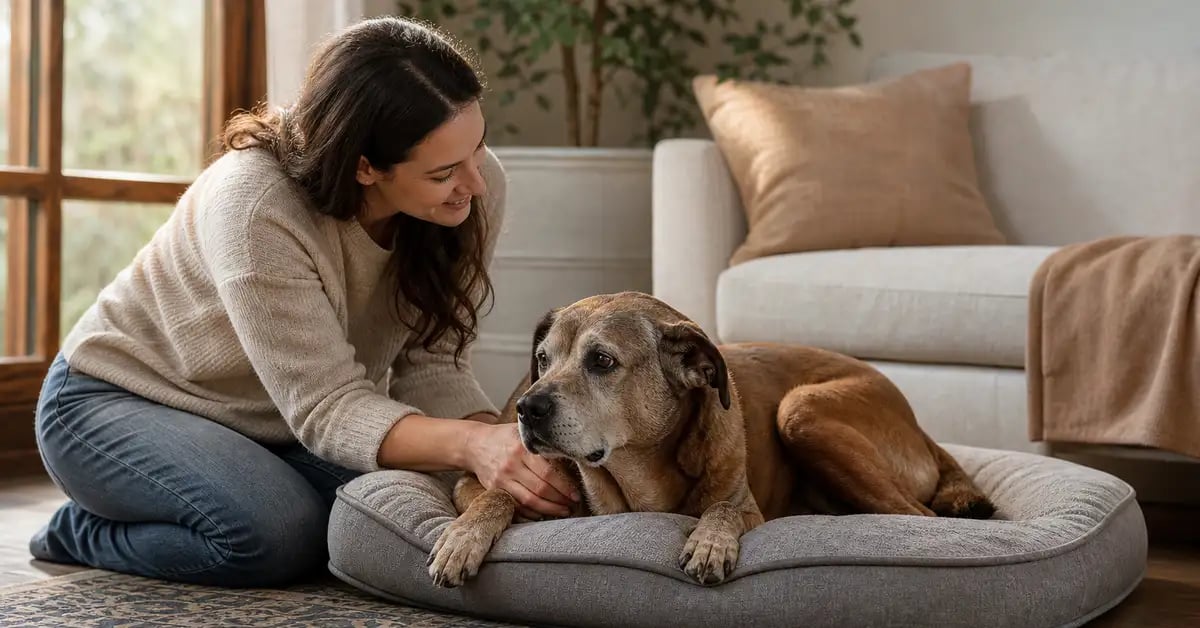
For senior or mobility-impaired dogs: entry height matters. A high bolster perimeter can be a barrier for a dog with arthritic hips or limited forelimb extension. Look for a bed with an open front, a lowered entry edge, or a flat platform design. Pair the bed with a non-slip rug underneath to prevent sliding on hard floors. If your dog also has trouble getting on and off furniture, see our best dog ramps guide or best dog stairs & steps guide — both help take strain off arthritic joints.
For dogs with incontinence: waterproof liner is non-negotiable. Surface-resistant covers aren't enough — urine seeps through seams under pressure. You want a separate waterproof layer between the cover and the foam. The PetFusion, Dogbed4less, and Brindle all include this; for others, add a separate waterproof dog bed liner.
Planning a full senior-dog comfort setup?
See our ramp picks →What Makes a Bed Genuinely Orthopedic?
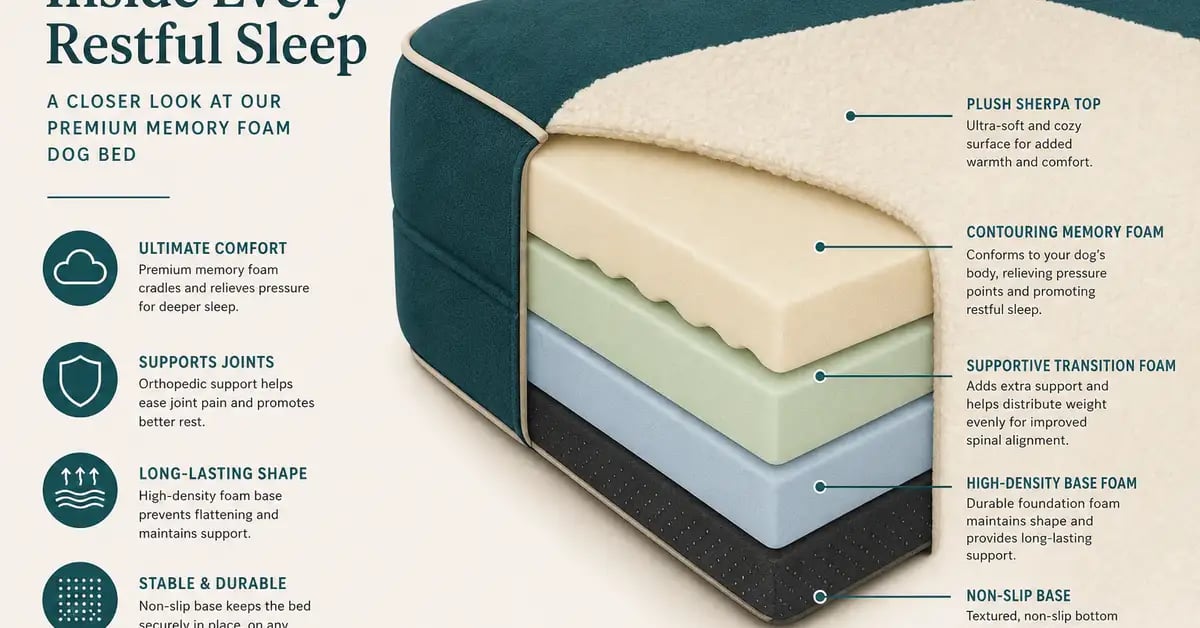
Because "orthopedic" is an unregulated marketing term, you need to evaluate beds by their specs rather than their labels. Here's how to read past the packaging:
Foam type. True memory foam (polyether polyol construction) contours to the dog's body under warmth and pressure and springs back when they get up. This is the gold standard for pressure relief. Egg-crate foam distributes pressure across its ridged surface — less contouring, but durable and often CertiPUR-US certified. Poly-fill — the cotton-ball-like stuffing found in cheap beds — compresses quickly and offers minimal support. It's not orthopedic by any meaningful standard.
Foam thickness ("not bottoming out"). The key criterion is whether your dog's joints touch the floor when they lie down. For large breeds, 4 inches of memory foam is a minimum; 7 inches (as in the Big Barker) is better. Thinner foam may compress under the dog's full weight in one spot. Check whether the product listing specifies foam depth — if it doesn't, that's a flag.
Certifications. CertiPUR-US verifies that polyurethane foam is made without ozone-depleting chemicals, heavy metals, or formaldehyde, and has tested within safe bounds for volatile organic compound emissions. OEKO-TEX certifies textiles. These aren't orthopedic performance standards, but they do confirm material safety — relevant because dogs spend 12–18 hours a day resting and may lick or chew the fabric. The Big Barker and FurHaven Snuggery both carry CertiPUR-US certification; it's worth looking for on any foam bed you consider.
Warning signs. Vague descriptions like "foam-filled" without specifying type or depth; extremely low prices for a large-breed bed (high-density foam isn't cheap); heavy emphasis on aesthetics while saying nothing about support criteria; or beds described as "plush," "cloud-like," or "ultra-soft" without any mention of joint relief — all worth scrutinizing before you buy.
New to dog gear research?
Our Dog Gear hub covers every major category — from dog beds to harnesses and more — all research-led and honestly chosen.
Browse dog gear → All dog beds →Frequently Asked Questions
This article is general information for dog owners, not veterinary advice. If your dog shows signs of joint pain, lameness, or mobility difficulties, consult your veterinarian for a diagnosis and treatment plan. An orthopedic bed can support your dog's comfort, but it doesn't replace veterinary care.
Sources: AKC Canine Health Foundation — Canine Arthritis; Orthopedic Foundation for Animals (OFA); CertiPUR-US Foam Certification Program; Big Barker / University of Pennsylvania Clinical Study; Rover — Best Orthopedic Dog Beds; Hepper — Best Orthopedic Dog Beds 2026; MedVet — Hip Dysplasia in Dogs.